Empire
of Mexico
Imperio Mexicano
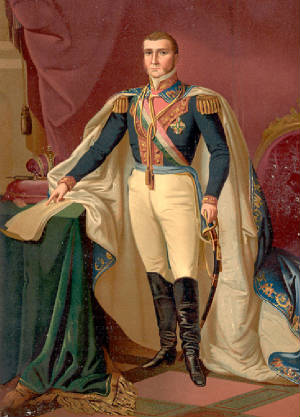
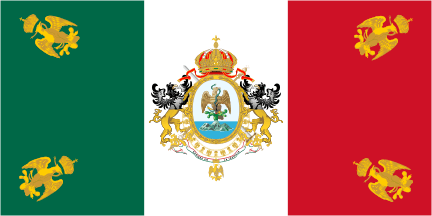
The First Mexican Empire was the official name
of independent Mexico under a monarchical regime from 1821 to 1823. The territory of the Mexican Empire included the continental
intendencies and provinces of New Spain proper and those of the former Captaincy General of Guatemala. After the declaration
of independence on September 28, 1821, it was the intention of the Mexican parliament to establish a commonwealth whereby
the King of Spain, Ferdinand VII, would also be Emperor of Mexico, but in which both countries were to be governed by separate
laws and with their own legislative offices. Should the king refuse the position, the law provided for a member of the House
of Bourbon to accede to the Mexican throne. Ferdinand VII, however, did not recognize the independence and said that Spain
would not allow any other European prince to take the throne of Mexico. By request of Parliament, the president of the regency
Agustín de Iturbide was proclaimed emperor of Mexico.
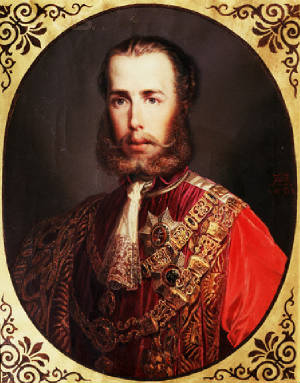
The Second Mexican Empire was the name of Mexico under the
regime established from 1864 to 1867. For the earlier monarchy in Mexico in 1821-1823, It was created by Napoleon III of France,
who attempted to use the Mexican adventure to recapture some of the grandeur of earlier Napoleonic times. The military intervention
put Archduke Ferdinand Maximilian of Austria on the Mexican Throne as Maximilian I of Mexico. It was promoted and installed
by the French, with some support from the Austrian and Spanish Crowns, in order to create a European-style monarchical system
in Mexico. The French also had support from conservativeelements within Mexico, such as the Mexican nobility, who were looking
for a way to promote stability and end the constant cycle of unrest and revolution.
Imperial House of Iturbide
The House of Iturbide is the former Imperial House of Mexico. It was founded by Agustín de Iturbide in 1822 when the newly independent Mexican congress confirmed his title of Agustín I, Constitutional Emperor of Mexico. It is sometimes called the Imperial
House of Habsburg-Iturbide as a memoir to Maximilian
I of Mexico of the House of Habsburg who ruled as Mexican
emperor from 1864-1867 during the Second Mexican Empire. After Mexico was declared and recognized as an independent state,
Iturbide was backed and influenced by Mexico's conservadores
who favored an independent Mexico with a monarch from
one of the European royal families as head of state. When no European royals accepted Mexico's offer (as Spain still had hopes of taking Mexico back), Iturbide was persuaded by his advisers to be named Emperor in the manner of Napoleon I. The House of Iturbide still continues today, but the male line had died out with Don Agustin and his cousin Don Salvador, the two adoptive sons of Maximilian I of Mexico. It continues today through the line of Don Salvador's daughter, Doña Maria Josepha
Sophia de Iturbide. The House of Iturbide holds no recognition
from the Mexican government, nor does it serve in protocolary
events.
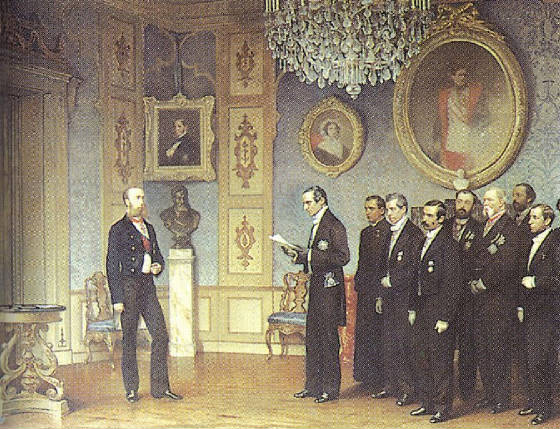
Line of
succession to the Imperial Throne of Mexico
Since the deposition of Maximilian I as Emperor of Mexico, there has been a pretender line of accession to the throne, through his adopted sons - the grandsons of Agustin I. The current Pretender to the throne of Mexico is Maximilian von Götzen-Iturbide,
born in 1944. He is not a male-line descendant, but inherited
his claim following the death of his grandmother Maria
Josepha Sophia de Iturbide, who was the daughter of Salvador
de Iturbide y de Marzán, Emperor Maximilian's adoptee. Maximilian von Götzen-Iturbide resides in Australia. Should this entire line fail, along with all other descendants of Agustín de Iturbide, the next likely successor might be the emperor's sister, Doña Josefa.
Family Titles and Styles of the Imperial House
The Sovereign bears the title and style of: by the grace of God and will of the people,
Emperor of Mexico, with the formal appellation of His Imperial Majesty, the consort of the Sovereign: Empress of Mexico, with
the formal appellation of Her Imperial Majesty, the Heir Apparent: the Prince Imperial of Mexico, with the formal appellation
of His Imperial Highness, the younger sons of the Sovereign: Prince Don, de Iturbide é , Mexican Prince, with the formal
appellation of His Highness, the daughters of the Sovereign: Princess Doña, de Iturbide é, Mexican Princess,
with the style of Her Highness, other members of the family in the male line bear and enjoy the title of Prince or Princess
de Iturbide, with the formal appellation of Highness.
The Genealogy of the lmperial House of Itúrbide
Don Pedro de, of Irisarry, Lower Navarre.
b. ca 1610. m. Doña Graciana de Churitegui (aka Churruqueta or Churubeque) (b. ca 1615). had issue:
1) Don Bernardo de Itúrbide
é Churitegui. b. ca 1635. Removed from Irisarry to Villa de Falces, Navarre. m. at Falces, Navarre, 20th October 1660,
Doña Isabel de Mendiondo y Sola (b. at Falces, Navarre, 26th November 1640), issue:
a) Don José de Itúrbide
é Mendiondo. bapt. at Templo de Sta María, Falces, Spain, 21st February 1666. m. at Peralta, Spain, 27th May
1691, Doña Antonia de Irigaraya é Orduña (b. ca 1670), issue:
i) Don José Salvador de Itúrbide
é Irigaraya. bapt. at the Church of San Juan Evangelista, Peralta, Spain, 5th May 1693. m. 8th February 1711, Doña
Magadalena Alvarez de Eulate é Bicuña (b. at Peralta, ca 1695), issue:
(1) Don José de Itúrbide é
Alvarez de Eulate. b. at Peralta, Spain, 3rd November 1711 (bap. 5th November 1711). m. at Peralta, Spain, 8th December 1737,
Doña María Josefa de Arreguí é Castelú (b. ca 1715), issue:
(a) H.H. Don José
Joaquín de Itúrbide é Arreguí, Prince of the Union. bapt. 6th February 1739, m. (first) in Spain,
Doña Vicenta de Auzla (d. ca 1765). m. (second) at Pueblo de Sta Clara de los Cobres, Michoacàn, Mexico, 21st
November 1772, Doña María Josefa de Arámburo é Carrillo de Figueroa (b. in Michoacàn, Mexico,
ca 1740; d. at Mexico City, 3rd December 1820, bur. Panteon de San Pablo), d. 19th November 1825, issue:
(i) Don Guilhermo de Itúrbide
é Auzla b. at Cambo, 27th June 1764, m. 1802, Jeanne, née Deyhins, d. at Bayonne, 10th October 1831, issue:
1.
Michel d'Yturbide. b. at Bayonne, 29th May 1810, m. Marie-Louise (b. at Bayonne, 17th December 1824; d. at Biarritz, 18th
April 1903), d. at Bayonne, 27th November 1865, issue:
a. Charles d'Yturbide. b. at Bayonne, 26th May 1846, m.
(first) 27th March 1878, Catherine née Moreau (d. 1881). m. (second) at Biarritz, 15th September 1883, Catherine Marie
(b. at St Servan; d. at Biarritz, 13th January 1925), d. at Eaux-bonnes, Lower Pyrénées, 10th August 1907, issue:
i.
Captain Albert d'Yturbide. b. at Paris, 30th September 1878, m. at Cholet, Maine and Loire, 1909, Christine, née de
Thénaisie (d. at Angers, April 1971) d.s.p. at Angers, 1948.
ii. Captain Pierre d'Yturbide. b. at Biarritz,
4th January 1887, d. unm. at Brest, 29th November 1926.
i. Claire. b. at Biarritz, 4th January 1887 (d/o Catherine
Marie), educ. m. at Biarritz, 13th July 1923, Professor Léon Goa, DSc (b. at Biarritz, 27th June 1873; d. there, 14th
October 1943), d. at Bayonne, 26th December 1973, issue.
(ii) Don José Francisco de Itúrbide é
Arámburo. b. at Vallodolid, Michoacán, 25th November 1775 d.s.p.
(iii) Don José Apolinario Cristobal de
Itúrbide é Arámburo. bap. at the Metropolitan Sagrario Vallodolid, Michoacán, 25th July 1777 .
d.s.p.
(iv) Don Agustín Cosme Damiàn de Iturbide é Arámburo, who became Agustin I, Emperor of
Mexico.
(v) Don Francisco Manuel de Itúrbide é Arámburo. bap. at the Metropolitan Sagrario
Vallodolid, Michoacán, 6th October 1785.
(vi) Don José Mariano Ilarion de Itúrbide é Arámburo. bap. at
the Metropolitan Sagrario, Vallodolid, Michoacán, 23rd October 1790.
(i) H.H. Princess Doña María Nicolasa
de Itúrbide é Arámburo, b. 15th September 1774, d. unm. at Mexico City, 4th February 1840.
(ii) Doña María
Ignacia Juana de Itúrbide é Arámburo. bap. at the Metropolitan Sagrario Vallodolid, Michoacán,
26th November 1778. She d. unm.
(iii) Doña María Josefa Simphorosa de Itúrbide é Arámburo.
bap. at the Metropolitan Sagrario Vallodolid, Michoacán, 23rd July 1780 (d/o María Josefa). m. at Valladolid,
Michoacàn, 18th September 1797, Don José Antonio Sánchez de Manzanera é Ponce de Leon (b. at Lorca,
Spain, 1739; d. at Canatlan, Durango, Mexico, 4th May 1826) d. at Canatlan, Durango, Mexico, 1820, issue:
1. Don José Joaquín
de los Desamparados de Manzanera é Itúrbide. bap. at the Metropolitan Sagrario, Victoria de Durango, 15th May
1804.
2. Don Francisco de Manzanera é Itúrbide. b. at Santiaguillo, Canatlan, Durango, 1812. m. Doña
Juana Rocha, issue:
a. Don Florencio de Manzanera é Rocha.
a. Doña Carlota de Manzanera é Rocha.
1. Doña María
Ignacia de Manzanera é Itúrbide. m. Don Eduardo García. She d.s.p.
2. H.H. Princess Doña
María Josefa de Manzanera é Itúrbide. b. at Valladolid, Michoacàn, 6th October 1800. m. at Canatlán,
Durango, 18th November 1817, Colonel Señor Don Juan Bautista de Landa y Mendieta (b. at Durango, Nueva Vizcaya, 26th
June 1789; d. 18xx), issue:
a. Don Aciano de Landa y Manzanera. b. at Mexico City, 7th September 1820.
b. Don Agustín de
Landa y Manzanera. b. at Mexico City, 17th February 1824.
c. Don Pedro de Landa y Manzanera.
a. Doña María
de la Concepción de Landa y Manzanera. b. at Mexico City, 1832. m. at the Oratorio del Obispo de Tenagra, Mexico City,
15th June 1855, Don Juan María de Icaza é Iturbe (b. at the Hacienda del Ojo, Durango, 1825; d. at Durango,
30th April 1898), issue:
i. Don José Ignacio de Icaza y Landa. b. at Mexico City, 7th March 1857, m. at Santa
Brígida, Mexico City, 16th May 1881, Doña Valentina María Guadalupe Camacho y Pizarro (b. at Mexico City,
15th February 1860; d. there 16th February 1941, bur. in the crypt of Mexico City Cathedral), d. at Mexico City, 10th
May 1933, issue:
1a. Don José Ignacio de Loyola Eulogio José de Arimatea Luis Gonzaga Tomás de Aquino
Eduvigen Matías Domingo del Dulce Nombre de los Sagrados Corazones de Jesús y de María de Icaza y Camacho.
b. at Mexico City, 11th March 1886. m. at Santa Brígida, Mexico City, 13th January 1912, Doña María Catarina
Cabrera y Ordeñana (b. at San Francisco, California, USA, 27th May 1884; d. Standford, California , 5th March 1975),
d. at Ross, California, USA, 18th December 1930, issue.
2a. Don Juan de Icaza y Camacho. b. at Mexico City, 1st July
1889. m. (first) Doña María de la Concepción Icaza-Mayora, e d. at Mexico City, 17th November 1953, issue.
1a.
Doña María Guadalupe Eufrasia Josefa Luisa Gonzaga Encarnación de Icaza y Camacho. b. at Mexico City,
13th March 1882. m. 1st October 1904, Albino Acereto y Cortés (b. at Cansahcab, Yucatán, 5th June 1875; d.
at Mexico City, 19th August 1948), d. at Mexico City, 14th December 1954, issue.
2a. Doña María
de la Concepción Dolores Matea Luisa Gonzaga Ignacia de los Sagrados Corazones de Jesús y María de Icaza
y Camacho. b. at Mexico City, 16th September 1883, d. young.
ii. Don Francisco Javier de Icaza y Landa. b. at Mexico City,
6th March and d. 7th March 1859.
iii. Don Francisco Javier Inés Anselmo Guadalupe Federico Tomás de Aquino
Juan de Dios Domingo Fausto Francisco de Paula Agustín Eduviges Matias Pascual Luz Ignacio Juan Francisco Regis del
Sagrado Corazón de Jesús de Icaza y Landa. b. at Mexico City, 20th April 1860. m. at Durango, 8th January
1892, Doña María de los Dolores Trinidad López de Negrete y Salcido (b. at Durango, 15th October 1874;
d. at Mexico City, 6th August 1948), d. at Mexico City, 22nd May 1934 (bur. there in the crypt of Mexico City Cathedral),
issue:
1a. Don Xavier de Icaza y Lopez de Negrete. b. at Durango, 2nd October 1892, m. Doña Ana Guido (b. 9th
April 1904; d. at Mexico City, 18th March 1990), d. at Mexico City, 1969, issue.
2a. Don Luis de Icaza y Lopez
de Negrete.
3a. Don Juan de Icaza y Lopez de Negrete. b. at Mexico City, 16th May 1902. m. Sadie Mae Conrey. He d.
19th June 1967, issue.
1a. Doña Dolores de Icaza y Lopez de Negrete. m. Ventura Martínez-del-Río
y Bermejillo (d. 19th January 1954). d. 27th June 1962, issue.
2a. Doña María de Lourdes de Icaza y Lopez de
Negrete. m. Eustaquio Martínez-del-Río, issue.
3a. Doña María de Guadalupe de Icaza y Lopez
de Negrete. b. at Mexico City, 25th May 1910. m. Joaquín Arregunaga, d. 21st May 1975, issue.
iv. Don Rafael María
de Guadalupe Eduviges Ignacio de Loyola Luis Gonzaga Juan Francisco Regis Domingo de Guzmán Trinidad Francisco de Paula
Manuel del Sagrado Corazón de Jesús Fausto Federico Vicente Ferrer Isidro Antonio de Icaza y Landa. b. at Mexico
City, 24th October 1863, m. at the Templo de la Encarnación, Mexico City, 19th October 1889, Doña Manuela Mayora
y Carpio (b. at Mexico City, before 4th February 1868), issue:
1a. Don José Ramón de Icaza y Mayora.
2a. Don Isidro Antonio de
Icaza y Mayora.
3a. Don Juan María de Icaza y Mayora.
4a. Don Rafael de Icaza y Mayora.
1a. Doña María
Manuela de Icaza y Mayora. m. Néstor Fuentes, issue.
2a. Doña María de la Luz de Icaza y Mayora.
3a.
Doña María de la Concepción de Icaza y Mayora. m. as his first wife, Don Juan de Icaza y Camacho (b.
at Mexico City, 1st July 1889; m. second, Doña Rosario Martínez, and d. at Mexico City, 17th November 1953,
bur. there at the Panteón Francés), issue.
b. Doña Petra de Landa y Manzanera. b. at Mexico City,
30th June 1819.
c. Doña Dolores de Landa y Manzanera. b. at Mexico City, 3rd March 1822.
3. Doña María
Eduwigis Sánchez de Manzanera é Itúrbide. b. at Santiaguillo, Canatlan, Durango, 1804. m. Don Nicolás
Coronel. She d.s.p.
4. Doña María Remigia de Manzanera é Itúrbide. m. at San Diego De Alcala, Canatlan,
Durango, 25th May 1823, Don Manuel Manzanera.
5. Doña María Isidra de Manzanera é Itúrbide. m. Don Rafael
Castañeda. She d.s.p.
6. Doña María Perfecta de Manzanera é Itúrbide. b. at Cacaria,
Canatlan, Durango, 1810. m. (div. 1849) Don Francisco Lopez de Zubiría y Escalante (b. at Arizpe, 1798; m. second,
Petra Riopedre, issue:
a. Don Antonio Lopez de Zubiría é Manzanera. A priest.
b. Don Martín Lopez
de Zubiría é Manzanera. m. Doña Victoria Peña.
c. Don Santiago Lopez de Zubiría é
Manzanera. b. 29th November 1834. Ordained as a priest 1858, Archbishop of Durango 1895-1909. d. unm. at Durango, 25th
January 1909.
d. Don Francisco Lopez de Zubiría é Manzanera.
e. Don Andrés Lopez de Zubiría
é Manzanera. m. Doña Rosa Macedo.
a. Doña Petra Lopez de Zubiría é Manzanera. m. Licenciado Don Tomás
Chávez.
b. Doña Perfecta Lopez de Zubiría é Manzanera.
c. Doña Isabel Lopez de Zubiría é Manzanera. A nun.
d. Doña Luisa Lopez
de Zubiría é Manzanera. m. Don Francisco Alvarez.
e. Doña Carmen Lopez de Zubiría é Manzanera.
f.
Doña Clemencia Lopez de Zubiría é Manzanera.
g. Doña Paulina Lopez de Zubiría é Manzanera.
m. Don Juan de Zubiría.
h. Doña María Lopez de Zubiría é Manzanera.
i. Doña Valentina
Lopez de Zubiría é Manzanera. m. Licenciado Don Manuel Ríos.
(iv) Doña María Ana Ignacia de
Itúrbide é Arámburo. bap. at Vallodolid, Michoacán, 3rd August 1788 (bap 4th August). She d. young.
(b)
Doña Angela Itúrbide é Arreguí. b. at Peralta, ca 1740. m. at Peralta, 6th November 1757, Don
Domingo Malo y Marcilla (bap. at Villafranca, 29th May 1735), younger son of Don Domingo Fermin Malo y Ydalgo, of Villafranca,
by his wife, Doña Polonia Marcilla y Lissarri, d. at Villafranca, 27th October 1797, issue:
(i) Don Antonio María
Malo é Iturbide. bap. at Peralta, 29th March 1761. m. (first) at Villafranca, 20th March 1791, Doña Raphaela
Urzainqui y Diez, m. (second) at Villafranca, 14th November 1814, Doña Maria Bienzobas y Garcia, a widow, issue.
(ii) Brigadier The Most Excellent
Señor Don Domingo Hermenegildo Malo é Iturbide. bap. at Peralta, 16th April 1764. (1822). m. Doña Maria
Francisca Ortiz, issue.
(iii) Don Juan de la Cruz Joseph Xavier Malo é Iturbide. bap. at Villafranca, 26th
November 1766. m. (first) at Villafranca, 21st May 1792, Doña Maria Peralta y Mañas, m. (second) at Villafranca,
4th November 1794, Doña Gregoria Robres y Germauta, issue.
(iv) Don Felipe Santiago Malo é Iturbide. bap. at Villafranca,
1st May 1771. m. at Villafranca, 1st May 1815, Doña Angela Peralta y Bartholome-Ros, d. 6th August 1833, issue.
(v)
Don Placido María Malo é Iturbide. bap. at Villafranca, 5th October 1777.
(i) Doña Ysidra Malo
é Iturbide. bap. at Villafranca, 16th May 1769.
(ii) Doña Felipa María Malo é Iturbide.
bap. at Villafranca, 26th May 1773.
(iii) Doña Josepha Florentina Malo é Iturbide. bap. at Villafranca, 15th March
1780. m. at Villafranca, 30th June 1803, Don Josef Aniceto Arrondo y Frago (bap. at Villafranca, 20th March 1781; d. there,
4th July 1826), d. at Villafranca, 20th March 1848, issue.
a) Doña Isabel de Itúrbide é Mendiondo.
b. at Falces, Navarre, 24th June 1664. m. as his second wife, Joseph Yrigoyen y Los Arcos (b. at Falces, Navarre, 30th March
1659; d. at Traibuenas, 15th September 1715), d. at Traibuenas, 6th December 1712, issue.
1821 - 1823 H.M. Don Agustín I, by Divine
Providence and by the Congress of the Nation, Constitutional Emperor of Mexico. b. at Valladolid, Michoacán, 27th September
1783, m. at the Cathedral of the Divine Savioir, Valladolid, Michoacán, 27th February 1805, H.M. Empress Doña
Ana María (b. at Valladolid, Mexico, 17th January 1786; d. at Philadelphia, USA, 21st March 1861, d. at Padilla,
Tamaulipas, Mexico, 19th July 1824, issue:
1) H.I.H. The Most Excellent Señor Don Agustín Jerõnimo José
de Iturbide é Huarte, Prince Imperial of Mexico. b. at Valladolid, Mexico, 30th September 1807, d. unm. at New York,
USA, 11th December 1866.
2) H.H. Prince Don Ángel María José Ignacio Francisco de Xavier de Yturbide é
Huarte. b. at Querétaro, 2nd October 1816, m. at Rosedale, Georgetown, DC, USA, 1862, Doña Alicia de Yturbide
Grin (d. at Mexico City, 28th January 1892), née Alice Green, d. at Mexico City, 28th January 1872, issue:
a) H.H. Prince Don Agustín
de Iturbide é Grin, Prince Imperial of Mexico.
3) H.H. Prince Don María de Jesus de Iturbide é Huarte. b. at Mexico City,
22nd February 1818. d. unm. at Philadelphia, USA, 10th July 1849.
4) H.H. Prince Don Salvador María de Yturbide é
Huarte. b. at the Palacio Moncada, Mexico City, 17th July 1820, m. 1848, Doña María del Rosario Felipa
de Jesús Marzán y Guisasola (b. at Mexico City, before 6th February 1823; d. March 1859) d. Nayarit, 7th June
1856, issue:
a) H.H. Prince Don Salvador Agustín Francisco de Paula de Iturbide é Marzán. b. at
Mexico City, 18th September 1849, 1st m. at Mikos Castle, Mikosd, Hungary, 21st June 1871, H.H. Princess Doña
Gizella María Terezia de Iturbide (b. at Széplak, Hungary, 1st February 1846; m. second, at Paddington, London,
4th August 1900, Emil Jenison, Count von Walworth, who d. at Nice, France, 10th January 1910; and d. Graz, Austria,
1st April 1921), d. at Ajaccio, Corsica, 26th February 1895, issue, :
i) H.H. Princess Doña María Josefa
Sophia de Iturbide é Mikos de Tarrõdhàza. b. at Mikosd, Hungary 29th February 1872. m. (first) at Beszterce,
12th March 1908, Captain Baron Johann Nepomuk Adolf Ferdinand Josef Tunkl von Aschbrunn und Hohenstadt. (b. at Köszeg,
Hungary, 12th July 1872; k-i-a at Onuth, Bukovina, 10th May 1915), m. (second) at Beszterce, Hungary, 14th April 1823,
Charles de Carriere (b. at Paris, France, 24th November 1875; d. at Dévabànya internment camp, Rumania, November
1949), d. at Dévabànya internment camp, Rumania, November 1949, issue:
(1) Baroness María Anna Wilhelmina Adolphina
Tunkl Yturbide, née Tunkl von Aschbrunn und Hohenstadt. b. at Temesvàr, Hungary, 4th August 1909.
(2) Baroness María
Gizela Josefa Izabela Tunkl Yturbide. b. at Temesvàr, Hungary, 2nd October 1912 . m. (first) at Beszterce, 8th June
1940, Count María Gustav Adolf Egon von Götzen (b. at Grusbach, Moravia, 25th September 1904; d. at Caracas, Venezuela,
11th May 1956). m. (second) at Montevideo, Uruguay, 15th August 1959, Ottavio Stefano della Porta (b. at Gran, 14th November
1890; d. at Montevideo, Uruguay, 24th February 1971), d. at Sydney, Australia, 27th January 1981, issue :
(a) Count Maximiliano Gustav
Richard Albrecht Agustin Götzen-Yturbide. b. at Beszterce, Hungary, 2nd March 1944 (s/o Count von Götzen). m. at
Melbourne, Australia, 22nd September 1990, Anna Rosa María Helena (b. at Sydney, Australia, 16th October 1966), issue:
(i) Count Ferdinand Leopold
Maximilian Gustav Salvador Götzen-Yturbide. b. at Perth, Western Australia, 26th August 1992.
(i) Countess Emanuella Isabella
Charlotte Helena von Götzen-Yturbide. b. at London, 9th September 1997.
(b) Countess Emanuela (Emma) Huberta Johanna
María Gizela Götzen-Yturbide. b. at Beszterce, Hungary, 12th September 1945. m. at Perth, Western Australia, 19th
October 1968 (div. there, November 1999), Patrick Francis Philip MacAulay (b. at Bombay, India, 20th July 1936), issue:
(i)
Nicholas MacAulay. b. 1970.
(ii) Edward MacAulay. b. 1973.
(iii) Agustin MacAulay. b. 1977.
(iv) Patrick MacAulay. b.
1979.
(v) Philip MacAulay. b. 1981.
(i) Camilla MacAulay. b. 1972.
(ii) Gizela MacAulay. b. 1985.
ii) H.H. Princess Doña
María Gizela Anna de Iturbide é Mikos de Tarrõdhàza. b. at Mikosd, Hungary, 10th June 1874, d.
Szombathely, Hungary, 14th February 1875.
iii) H.H. Princess Doña María Terezia de Iturbide é Mikos de Tarrõdhàza.
b. at Gyulafehérvàr, Hungary, 26th February 1876. m. at Beszterce, Hungary, 1893, Lajos Zoltàn
Lékai Török de Aranyos-Rákos et Kadicsfalva (b. at Székelyudvarhely, Hungary, 1869; k. in a
hunting accident at Pancsova 1904), d. from cholera at Novodwor, Galicia, 7th August 1915.
5) H.H. Prince Don Felipe
Andrés María Guadalupe de Iturbide é Huarte. b. at the Palacio Moncada, Mexico City, 30th November 1822.
d. unm. from typhoid fever at Matamoros, Tamaulipas, 19th November 1853.
6) Lieutenant-Colonel H.H. Prince Don Agustín
Cosme de Iturbide é Huarte. b. posthumously, at New Orleans, USA, October 1824, d. unm. at Neuilly-sur-Seine, France,
10th May 1873 (bur. Neuilly Cemetery).
1) H.H. Princess Doña Sabina María de la Concepción de Iturbide é
Huarte. b. at Mexico City, 30th December 1810. Granted the title of Mexican Princess with the style of Her Highness, 22nd
June 1822. Settled in Paris in December 1865. She d. unm. at Philadelphia, USA, 15th July1871 (bur. there at the Church of
St John the Evangelist).
2) H.H. Princess Doña Juana de Dios María Francisca Ramona Ignacia de Iturbide
é Huarte. b. at Mexico City, 10th March 1812. Granted the title of Mexican Princess with the style of Her Highness,
22nd June 1822. She d. unm. at the Visitation Convent, Georgetown, Washington DC, USA, 2nd October 1828. (bur. there).
3)
H.H. Princess Doña Josefa de Iturbide é Huarte. b. at Irapuato, Guanajuato, 22nd December 1814. Granted the
title of Mexican Princess with the style of Her Highness, 22nd June 1822 and recognised as Princess de Iturbide by Emperor
Maximilian I, 13th September 1865. Guardian to her nephew H.H. Prince Don Agustin, She d. unm. at the Hotel Comonfort, Mexico
City, 5th December 1891.
4) H.H. Princess Doña María de Jesus de las Angustias Juana Nepomuceno de
Iturbide é Huarte. b. at Mexico City, 21st February 1818. Granted the title of Mexican Princess with the style of Her
Highness, 22nd June 1822. She d. unm. at Philadelphia, USA, 10th July 1849.
5) Doña María de los Dolores de
Iturbide é Huarte. b. at Mexico City, before July 1819. She d. at Mexico City, 10th July 1820 (bur. there at the Cemetery
of San Lazaro).
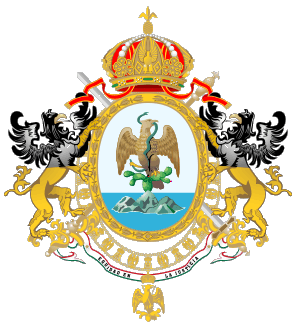
The
lmperial House of Habsburg-Lorraine
H.I.M.
Maximilian I (Spanish: Maximiliano I; 6 July
1832 - 19 June 1867) was the only monarch of the Second Mexican Empire. After a distinguished career in the Austrian
Navy, he was proclaimed Emperor of Mexico on 10 April 1864, with the backing of Napoleon III of France and a group of Mexican
monarchists who sought to revive the Mexican monarchy. Many foreign governments, including that of the United States, refused
to recognize his administration. This helped to ensure the success of republican forces led by Benito Juárez, and Maximilian
was captured and executed in 1867. Though criticised as naïve and indecisive, Maximilian is often praised by historians
due to his liberal reforms, his genuine desire to help the people of Mexico, his refusal to desert his loyal followers, and
his personal bravery during the siege of Querétaro. He has been highly praised even by historians who believe he had
no business becoming involved in Mexican affairs. In Mexico, he and his consort are known as Maximiliano and Carlota.
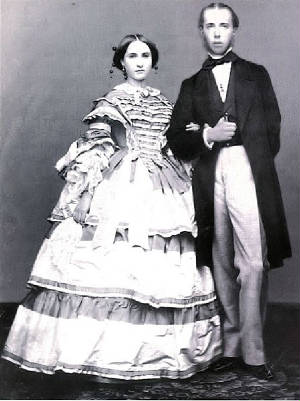
H.I.M.
Empress Doña María Carlota Amalia Augusta Victoria Clementina Leopoldina of Mexico, born Princess Charlotte of Belgium (Princess Marie Charlotte Amélie Augustine Victoire Clémentine
Léopoldine of Belgium) (7 June 1840 - 19 January 1927) is remembered today as Carlota of Mexico as empress consort
of Emperor Maximilian I of Mexico, Archduke of Austria. The
only daughter of Leopold I, King of the Belgians (1790-1865) by his second wife, Louise-Marie, Princess of France (1812-1850),
Charlotte was born at the Royal Castle of Laeken in Laeken, Brussels, Belgium. Charlotte had three brothers: Louis-Philippe,
who died in infancy, Leopold, who on the death of their father became Leopold II of Belgium and Philippe, Count of Flanders.
She was also a first cousin to both Queen Victoria of the United Kingdom and her husband, Prince Albert, as well as Ferdinand
II of Portugal. She belonged to the House of Saxe-Coburg and Gotha. Her favorite grandparent Maria Amalia of the Two
Sicilies, Queen of France, was the consort of Louis-Philippe of France, and a niece of Marie Antoinette. Maria Amalia was
Charlotte's close confidante, and on her wedding day in 1857, she wore a bracelet with a miniature portrait of her. They regularly
corresponded, especially later while Charlotte was in Mexico. When Charlotte was ten years old, her mother, Louise-Marie,
died of tuberculosis and Charlotte was entrusted to the Countess of Hulste, a close family friend. Although young, the princess
had her own household; but for a few weeks out of the year, Charlotte stayed in Claremont with Maria Amalia and the rest of
her mother's family in exile.
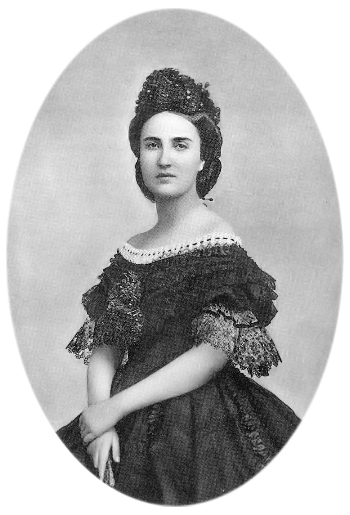
On 27
July 1857 in Brussels, Charlotte married her second cousin Archduke Maximilian of Austria, the idealistic younger brother
of Emperor Franz Josef of Austria. In the Court of Vienna she was much prized by her mother-in-law, who saw in her the perfect
example of a wife to an Austrian Archduke. Charlotte disliked Empress Elizabeth (also known as Sissi, Franz Josef's wife).
It is said that the archduchess disliked the deep connection that existed between the empress and Maximilian, who were confidantes
and shared the same tastes for many things, especially because her sister-in-law was universally admired for her beauty and
charms. Charlotte spent several relatively happy years in Italy as Maximilian's wife while the archduke served as governor
of the provinces of Lombardy and Venetia. Although Lombardy and Venetia were then under the rule of the Austrian Empire, neither
Maximilian nor Charlotte held real power, and both were fatally eager for more challenging roles in life.
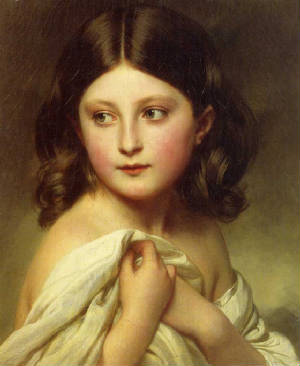
In the early
1860s, the ambitious Napoleon III initiated the French intervention in Mexico. France, eager to turn Mexico into a satellite
state, searched for a suitable figurehead to serve as the nominal emperor of Mexico. Maximilian accepted the Mexican crown
and the couple sailed for the New World. The imperial couple were crowned at the Catedral Metropolitana in 1864 and chose
as their seat Mexico City, making their home in the Neoclassical Castillo de Chapultepec. As Empress, Charlotte took the name
of Carlota (Spanish for Charlotte). Carlota tried to take her imperial duties seriously, and even undertook a tour of the
remote Yucatán frontier, visiting the ruins of Uxmal.
Only months after the coronation, however, Napoleon III
began signaling his abandonment of Maximilian, and the French began to withdraw their troops from Mexico. This strategic pullback
was a potentially fatal blow to the infant Mexican monarchy. The situation was exacerbated by a United States blockade that
prevented French reinforcements from landing. In a desperate attempt to save her husband's throne, Charlotte returned to Europe,
seeking assistance for her husband in Paris, Vienna, and finally in Rome from Pope Pius IX. Her efforts failed; she manifested
symptoms of paranoia, suffered a profound cognitive and emotional collapse, and never returned to Mexico.
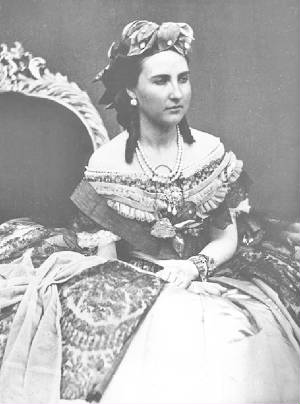
President
Benito Juárez of the Republic of Mexico oversaw the execution of Maximilian in 1867. (His last words were reportedly
of his absent wife: "Poor Carlota!"). The empire had collapsed after only three years. Carlota's mental state continued
to be poor. Her brother Prince Philippe, Count of Flanders, had her examined by alienists (psychiatrists), who pronounced
her insane. She spent the rest of her life in seclusion, first at Miramar Castle near Trieste, Italy, and then at the Castle
of Bouchout in Meise, Belgium. During World War I, her Belgian estate was surrounded by the occupying German army, but the
estate itself was sacrosanct because Austria was one of Germany's chief allies and she was the widowed sister-in-law of the
Austrian emperor. As Charlotte's illness progressed, her paranoia faded. She remained deeply in love with her husband.
After his death, she cherished all of the surviving possessions they had enjoyed in common. The bias of the historiography
of the time makes it difficult to assess to what extent she suffered from alleged mental conditions such as psychosis, paranoia
and monomania. Her considerable fortune as one of the richest women of Europe was administered by baron de Goffinet, a servant
of King Leopold II, who ensured that the money was used for his personal colonization of the Congo Charlotte died of pneumonia
brought on by influenza at the Bouchout Castle, in Meise, Belgium, on 19 January 1927, and is buried at the Church of Our
Lady of Laeken.