|
Kingdom
of Bohemia České království - Königreich Böhmen
The Kingdom of Bohemia (Czech: České království;
German: Königreich Böhmen; Latin: Regnum Bohemiae) was a country located in the region of Bohemia in Central Europe,
most of whose territory is currently located in the modern-day Czech Republic. The King was Elector of the Holy Roman Empire
until its dissolution in 1806, whereupon it became part of the Austrian Empire, and subsequently the Austro-Hungarian Empire
from 1867. Following the defeat of the Central Powers in World War I, both Kingdom and Empire were dissolved and Bohemia became
part of the newly formed Czechoslovak Republic. 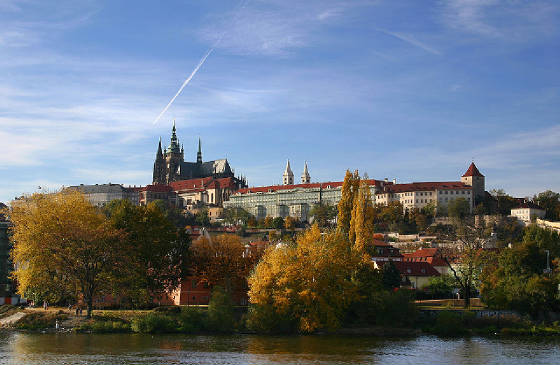
Although some former rulers of Bohemia had enjoyed
a non-hereditary royal title during the 11th and 12th century (Vratislaus II, Vladislaus II), the kingdom was formally established
in 1198 by Ottokar I, who had his regality acknowledged by Philip of Swabia, elected King of the Romans, in turn for his support
against the rival Emperor Otto IV. In 1204 Ottokar's royal dignity was accepted by Otto IV himself as well as by Pope Innocent
III and afterwards definitely confirmed by the Golden Bull of Sicily issued by Emperor Frederick II in 1212, promoting the
Duchy of Bohemia to the Kingdom status. Incorporated into the Habsburg Monarchy from 1526, it was dissolved in 1918 with the
fall of Austria-Hungary, when the last Bohemian king, Charles I of Austria, was forced out of power without abdicating. The
national assembly at Prague then deposed the Habsburg (Habsburg-Lorraine) dynasty and proclaimed the Czechoslovak Republic.
Prague Castle - the ancient seat of Bohemian dukes, kings and emperors; after 1918 office of the Czechoslovak and Czech presidents 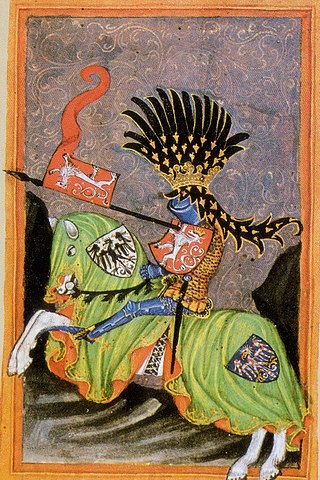
During the reign
of the last Přemyslids and the succeeding House of Luxembourg the Bohemian kingdom was the most powerful state of the
Holy Roman Empire.[citation needed] King Ottokar II of Bohemia ruled area through Austria to Adriatic Sea. King Wenceslaus
II was crowned King of Poland in 1300, his son Wenceslaus III King of Hungary one year later. That time the Kingdom of Bohemia
streched from Hungary till Baltic sea. Though both crowns were lost after Wenceslaus' III assassination in 1306, the rise
of Bohemia continued, when in 1346 the heir to the Bohemian throne, Charles of Luxembourg was elected King of the Romans and
crowned Holy Roman Emperor in 1355. The issue of the 1356 Golden Bull together with the following acquisition of the Brandenburg
Electorate gave the Bohemian Kingdom two votes in the electoral college. Charles made Prague the Imperial residence and his
son King Sigismund again acquired the Hungarian crown by marriage with queen regnant Mary of Hungary in 1385. His successors
- Ladislaus the Posthumous from Habsburg dynasty, George of Podiebrad and the rulers of the Jagiellon dynasty - strengthening
the status of Bohemia as an autonomous part of the Empire. In turn King Vladislav Jagiellon was disqualified by the prince-electors
from taking part in the 1486 election of Maximilian I of Habsburg in 1486. The estrangement from the Empire continued after
Vladislav had succeeded Matthias Corvinus of Hungary in 1490 and both the Bohemian and the Hungarian kingdom were held in
personal union. Not considered an Imperial State, the Lands of the Bohemian Crown were not part of the Imperial Circles established
by the 1500 Imperial Reform.
Territory under the control of the Přemyslid dynasty around year 1301 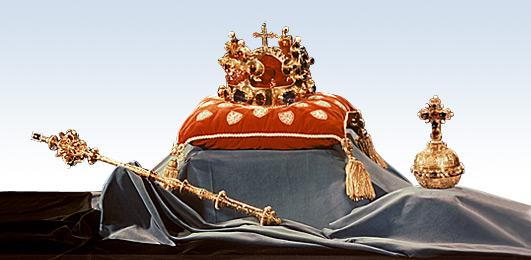
Bohemia proper (Čechy) with the County
of Kladsko (Hrabství kladské) was the main area of the Kingdom of Bohemia and from 1348 Charles IV created Lands
of the Bohemian Crown (Země Koruny české), together with the incorporated provinces: - The March of Moravia (Markrabství moravské),
acquired by Přemyslid and Slavník Bohemian rulers after the 955 Battle of Lechfeld, lost in 999 to Kingdom of
Poland and reconquered by Duke Bretislaus I in 1019/1029 (uncertain dating);
- Upper Lusatia (Horní Lužice), incorporated by King John of Bohemia in
1319 (Bautzen) and 1329 (Görlitz), and Lower Lusatia (Dolní Lužice), former Margraviate of Lusatia),
acquired by John's son Charles IV from Otto V, Margrave of Brandenburg in 1367. Ferdinand II of Habsburg lost the Lusatias
to the Electorate of Saxony with the 1635 Peace of Prague;
- The Duchies of Silesia (Slezsko), acquired by the 1335 Treaty of Trentschin between Jan Lucemburský
and King Casimir III of Poland. Queen Maria Theresa lost Silesia in 1742 to King Frederick II of Prussia by the Treaty of
Breslau, with the exception of Austrian Silesia
and, at times: - The Duchy of Austria in 1251, the Duchy of Styria in 1261, the Egerland in 1266, the Duchy
of Carinthia with the March of Carniola and the Windic March in 1269 and the March of Friuli in 1272, all acquired by King
Ottokar II Přemyslid and lost to Rudolph I of Germany in the 1278 Battle on the Marchfeld;
- The Egerland (Chebsko) was again obtained by Wenceslaus
II between 1291-1305; definitely given in pawn to Bohemia by Emperor (then King of the Romans) Louis IV in 1322 and subsequently
joined in personal union with Bohemia proper;
- The
northern part of the Upper Palatinate ("New Bohemia") at Sulzbach, incorporated by Charles IV in 1355. Charles'
son Wenceslaus lost the Upper Palatinate in 1400 to the Electorate of the Palatinate under King Rupert of Germany;
- The Brandenburg Electorate, acquired by Charles IV from Duke Otto
V of Wittelsbach in 1373. Charles' son Sigismund lost Brandenburg in 1415 to Frederick I, Elector of Brandenburg.
After the early
death of King Louis II Jagiellon at the Battle of Mohács in 1526, the Bohemian kingdom was inherited by his brother-in-law,
the Austrian Archduke Ferdinand I of Habsburg, younger brother of Emperor Charles V, whom he succeeded in 1558. The subsequent
incorporation of Bohemia into the Habsburg Monarchy against the resistance of the local Protestant nobility sparked off the
1618 Defenestration of Prague and the Thirty Years' War. Their defeat at the Battle of White Mountain in 1620 put an end to
the Bohemian autonomy movement. With
the dissolution of the Holy Roman Empire in 1806, the Bohemian kingdom was incorporated into the Austrian Empire and the royal
title retained by the Emperor of Austria. In the course of the 1867 Austro-Hungarian Compromise the provinces of Bohemia,
Moravia and Austrian Silesia became k. k. crown lands of Cisleithania. The current Czech Republic consisting of Bohemia, Moravia
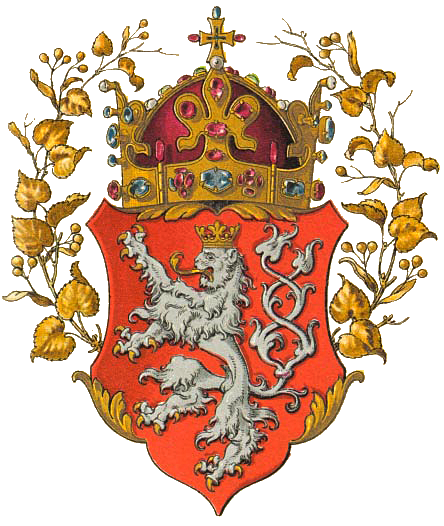
and Czech Silesia still uses some symbols of the Kingdom of Bohemia: a two-tailed lion in its coat-of-arms, red-white strips
in the state flag and the royal castle as the president's office. 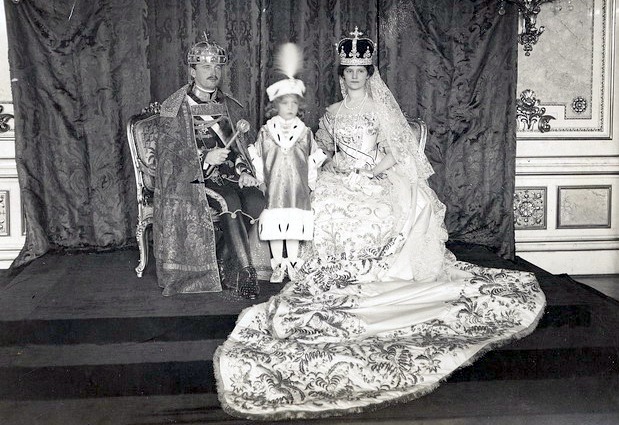 List of the Kings
of Bohemia | Přemyslid
dynasty | | Image |
Name | Date |
Notes |  | Ottokar I
(Přemysl I.
Otakar) | 1198-1230 |
Hereditary royal title approved by King Philip of Germany,
confirmed by the 1212 Golden Bull of Sicily |  | Wenceslaus I
(Václav
I.) | 1230-1253 |
Son of Ottokar I. |
 | Ottokar II
(Otakar II.) |
1253-1278 | Son of Wenceslaus I. Also Duke of Austria, Duke of Styria, Duke of
Carinthia and Duke of Carniola. |  | Wenceslaus II
(Václav
II.) | 1278-1305 |
Son of Ottokar II. Also Duke of Kraków (from 1291)
and King of Poland (1300-1305). |  | Wenceslaus III
(Václav
III.) | 1305-1306 |
Son of Wenceslaus II. Uncrowned (as Bohemian king). Also
King of Hungary and King of Poland. | | Non-dynastic |  | Henry the Carinthian
(Jindřich
Korutanský) | 1306 |
Meinhardiner. Son-in-law of Wenceslaus II. Non-crowned. |
 | Rudolph I
(Rudolf I.) |
1306-1307 | Habsburg. Second husband of Elisabeth Richeza of Poland, widow of
Wenceslaus II. Non-crowned. | | | Henry the Carinthian |
1307-1310 | Second time | | Luxembourg dynasty |  | John the Blind
(Jan Lucemburský) |
1310-1346 | Son-in-law of Wenceslaus II. |
 | Charles I
(Karel I.) |
1346-1378 | Son John. Also Holy Roman Emperor as Charles IV and generally known
as such. |  | Wenceslaus IV
(Václav
IV.) | 1378-1419 |
Son of Charles IV. Also King of the Romans until 1400. |
 | Sigismund
(Zikmund) |
1419-1437 | Brother of Wenceslaus IV. Ruled effective 1436-1437 only (because
of the Hussite Revolution). Also Holy Roman Emperor and King of Hungary. | | Habsburg dynasty | 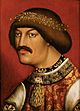 | Albert
(Albrecht Habsburský) |
1437-1439 | Son-in-law of Sigismund. Also King of the Romans and of Hungary. |
| | interregnum | 1440-1453 | The
succession of Albert's son was not recognized by the Czech nobility for the most of this era; the land was administered by
the landfriedens (provincial & territorial). | 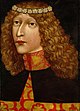 | Ladislaus the Posthumous
(Ladislav
Pohrobek) | 1453-1457 |
Son of Albert born after his father's death. Also King
of Hungary. | | Non-dynastic |
 | George of Podebrady
(Jiří
z Poděbrad) | 1457-1471 |
Elected king from the Czech noble family House of Kunštát.
Although he had descendants, the succession devolved to the prince from Polish kingdom. | 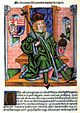 | Matthias I Corvinus
(Matyáš
Korvín) | 1469-1490 |
King of Hungary, elected by the insurgent Catholic Czech
aristocrats as antiking in 1469, but never crowned. In 1479, he agreed to limit his rule to Moravia, Silesia, and Lusatia,
while retaining his title. | | Jagiellonian dynasty | 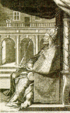 | Vladislaus II the Jagiellonian
(Vladislav II. Jagellonský) | 1471-1516 |
Nephew of Ladislaus the Posthumous; elected on request
of his predecessor George. Also King of Hungary after 1490. |  | Louis the Jagiellonian
(Ludvík
Jagellonský) | 1516-1526 |
Son of Vladislaus II. Also King of Hungary. |
| Habsburg dynasty |
 | Ferdinand I |
1526-1564 | Brother-in-law of Louis; elected king. Also King of Hungary and Holy
Roman Emperor-elect from 1558. | 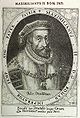 | Maximilian
(Maximilián) |
1564-1576 | Son of Ferdinand I, grandson of Vladislaus II. Also King of Hungary
and Holy Roman Emperor. |  | Rudolph II
(Rudolf II.) |
1576-1611 | Son of Maximilian I. Also King of Hungary and Holy Roman Emperor. |
 | Matthias
(Matyáš) |
1611-1619 | Brother of Rudolph II. Also King of Hungary and Holy Roman Emperor. |
 | Ferdinand II |
1619-1637 | Nephew of Matthias. Also King of Hungary and Holy Roman Emperor. |
 | Frederick |
1619-1620 | Member of the House of Wittelsbach. Antiking, elected by
the Crown's Estates at the beginning of the Thirty Years' War but after the lost Battle of White Mountain he fled the country. |
 | Ferdinand III |
1627-1657 | Son of Ferdinand II. Also King of Hungary and Holy Roman Emperor. |
 | Ferdinand IV |
1646-1654 | Son of Ferdinand III. Junior co-monarch during his father's reign.
Also King of Hungary and King of the Romans. |  | Leopold I | 1657-1705 | Brother of Ferdinand IV. Also King of Hungary and Holy Roman Emperor. |
 | Joseph I
(Josef I.) |
1705-1711 | Son of Leopold I. Also King of Hungary and Holy Roman Emperor. |
 | Charles II
(Karel II.) |
1711-1740 | Brother of Joseph I. Also King of Hungary and Holy Roman Emperor
as Charles VI. |  | Charles Albert
(Karel Albrecht) |
1741-1743 | Member of the House of Wittelsbach. Son-in-law of Joseph I. Antiking
to Maria Theresa during the War of the Austrian Succession. Also Holy Roman Emperor as Charles VII. |
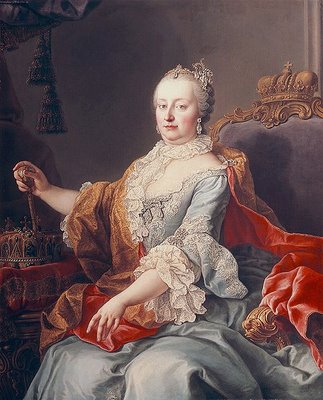
 | Maria Theresa
(Marie Terezie) |
1740-1780 | Daughter of Charles II. Also Queen of Hungary. |
| Habsburg-Lorraine
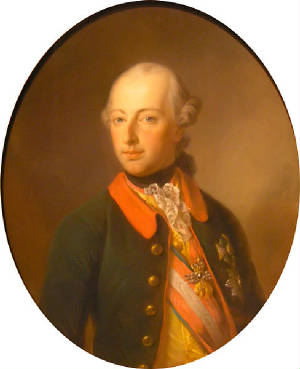
dynasty |  | Joseph II
(Josef II.) |
1780-1790 | Son of Maria Theresa. Also King of Hungary and Holy Roman Emperor. |
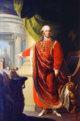 | Leopold II | 1790-1792 | Brother of Joseph II. Also King of Hungary and Holy Roman Emperor. |
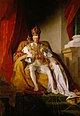 | Francis
(František) |
1792-1835 | Son of Leopold II. Also King of Hungary, Holy Roman Emperor to 1806,
Austrian Emperor from 1804. |  | Ferdinand V |
1835-1848 | Son of Francis. Also Austrian Emperor and King of Hungary. Last crowned
King of Bohemia. Lost power in the 1848 Revolution. |  | Francis Joseph
(František
Josef I.) | 1848-1916 |
Nephew of Ferdinand V. Also Austrian Emperor and King of
Hungary. |  | Charles III (Karel III.) |
1916-1918 | Grandnephew of Francis Joseph. Also Austrian Emperor and King of
Hungary. Ruled briefly during First World War and abdicated. |
The House of Habsburg-Lorraine The House of Habsburg or Hapsburg (also known as House of
Austria) was one the most important royal houses of Europe and is best known for being an origin of all of the formally elected
Holy Roman Emperors between 1438 and 1740, as well as rulers of the Austrian and Spanish Empires and several other countries.
Originally from Switzerland, the dynasty first reigned in Austria, which they ruled for over six centuries. A series of dynastic
marriages brought Burgundy, Spain, Bohemia, Hungary, and other territories into the inheritance. In the 16th century the family
separated into the senior Habsburg Spain and the junior Habsburg Austrian branches. 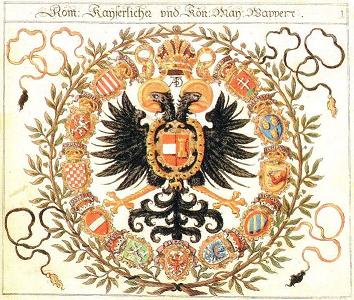
As
royal houses are by convention determined via the male line, the reigning branches of the House of Habsburg became extinct
in the 18th century. The Spanish branch ended upon the death of Charles II in 1700 and was replaced by the Anjou branch of
the House of Bourbon in the person of his great-nephew Philip V. The Austrian branch became extinct in 1780 with the death
of the Empress Maria Theresa and was replaced by the Vaudemont branch of the House of Lorraine in the person of her son Joseph
II. The new successor house styled itself as the House of Habsburg-Lorraine (German: Habsburg-Lothringen), therefore technically
there is not a House of Habsburg in the present day but only a female Habsburg line that exists in the House of Lorraine known as the House
of Habsburg-Lorraine. 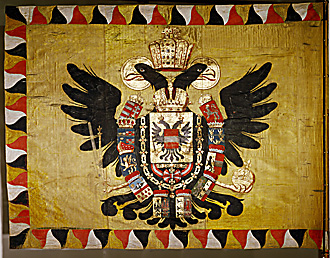
Titles
and Styles of The Imperial and Royal House The members of this family bear the titles "Archduke (Archduchess) of Austria, Prince
(Princess) of Hungary and Bohemia", and the style of "Imperial and Royal Highness". Descendants of morganatic
marriages, other than those granted specific titles (e.g., the Grafen von Meran and the Princes von Altenburg and Hohenberg)
generally bear the title "Graf (Gräfin) von Habsburg-Lothringen", or at least the surname "Habsburg". Genealogy of the Imperial and Royal House Part: I Maria Theresia, Archduchess of Austria, daughter of
Emperor Karl VI, was b.Vienna 13 May 1717; she succeeded her father as Queen of Hungary and Bohemia and heiress of Austria
on his death in 1740; she d.at Vienna 29 Nov 1780; she had married at Vienna 12 Feb 1736 Francis Stephen, Duke of Lorraine
(Lothringen) (Lunéville 8 Dec 1708-Innsbruck 18 Aug 1765), who in 1745 became the Emperor FRANZ I. Their issue:
1a) Marie Elisabeth Amalie Antonie Josephe Gabriele Johanna Agathe (Vienna 5 Feb 1737-Laxenburg
7 Jun 1740) 2a)
Marie Anna Josephe Antonie Johanna (Vienna 6 Oct 1738-Vienna 19 Nov 1789)
3a) Marie Caroline Ernestine Antonie Johanna
Josephe (Vienna 12 Jan 1740-Vienna 25 Jan 1741) 4a)
Emperor JOSEF II Benedikt August Johann Anton Michael Adam (Schönbrunn 13 Mar 1741-Vienna 20 Feb 1790); m.1st by proxy
at Parma 7 Sep 1760 and in person at Vienna 6 Oct 1760 Isabella Maria Pss of Bourbon-Parma (Madrid 31 Dec 1741-Vienna 27 Nov
1763); m.2d by proxy at Munich 13 Jan 1765 and in person at Schönbrunn 23 Jan 1765 Marie Josephe Pss of Bavaria (Munich
30 Mar 1739-Vienna 28 May 1767) 1b) Maria Theresia (Vienna 20 Mar 1762-Vienna 23 Jan 1770) 2b) Christina (b.and d.Vienna 22 Nov 1763) 5a) Marie Christine Johanna Josephe Antonie (Vienna 13 May 1742-Vienna 24 Jun
1798); m.Vienna 8 Apr 1766 Albert Pr of Saxony, Duke of Teschen (Moritzburg 11 Jul 1738-Vienna 10 Feb 1822)
6a)
Marie Elisabeth Josephe Johanna Antonie (Vienna 13 Aug 1743-Linz 22 Sep 1808) 7a)
Karl Joseph Emanuel Johann Nepomuck Anton Prokop (Vienna 1 Feb 1745-Vienna 18 Jan 1761) 8a)
Marie Amalie Josepha Johanna Antonie (Vienna 26 Feb 1746-Prague 18 Jun 1804); m.by proxy at Vienna 27 Jun 1769 and in person
at Colorno 19 Jul 1769 Ferdinando, Duke of Parma (Parma 20 Jan 1851-Fontevivo 9 Oct 1802) 9a)
Emperor Peter LEOPOLD II Joseph (Schönbrunn 5 May 1747-Vienna 1 Mar 1792), succeeded his brother, Emperor Joseph II,
on 20 Feb 1790; he m.by proxy at Madrid 16 Feb 1764 and in person at Innsbruck 5 Aug 1765 Maria Luisa Infanta of Spain (Naples
24 Nov 1745-Vienna 15 May 1792) 1b)
Maria Theresia Josephe Charlotte Johanna (Florence 14
Jan 1767-Leipzig 7 Nov 1827); m.by proxy at Florence 8 Sep 1787 and in person at Dresden 18 Oct 1787 King Anton of Saxony
(Dresden 27 Dec 1755-Pillnitz 6 Jun 1836) 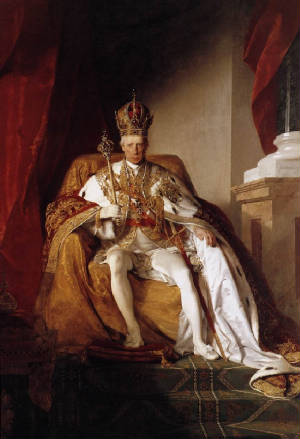 2b) Emperor
FRANZ II Joseph Karl, who in 1806 abdicated as Holy Roman Emperor and became Emperor FRANZ of Austria, (Florence 12 Feb 1768-Vienna
2 Mar 1835); m.1st Vienna 6 Jan 1788 Elisabeth Dss of Württemberg (Treptow 21 Apr 1767-Vienna 18 Feb 1790); m.2d by proxy
at Naples 15 Aug 1790 and in person at Vienna 19 Sep 1790 Maria Teresa Pss of Bourbon-Two Sicilies (Naples 6 Jun 1772-Vienna
13 Apr 1807); m.3d Vienna 6 Jan 1808 Maria Ludowika Archdss of Austia-Este (Monza 14 Dec 1787-Verona 7 Apr 1816); m.4th by
proxy at Munich 29 Oct 1816 and in person at Vienna 10 Nov 1816 Caroline Auguste Pss of Bavaria (Mannheim 8 Feb 1792-Vienna
9 Feb 1873) 1c) Ludovika Elisabeth Franziska (Vienna 18 Feb 1790-Vienna 24 Jun
1791) 2c) Marie
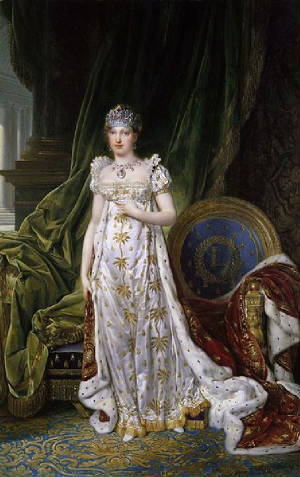
Louise Leopoldine Franziska Theresia Josepha Lucia, Dss of Parma, Piacenza and Guastalla 1814-1847 (Vienna 12 Dec 1791-Vienna
17 Dec 1847); m.1st by proxy at Vienna 11 Mar 1810 and in person (civ) at St.Cloud 1 Apr 1810 (rel) at the Louvre 2 Apr 1810
Napoléon I, Emperor of the French (Ajaccio 15 Aug 1769-St.Helena 5 May 1821); m.2d Parma 7 Sep 1821 Adam Adalbert Gf
von Neipperg (Vienna 8 Apr 1775-Parma 22 Feb 1829); m.3d Parma 17 Feb 1834 Cte Charles de Bombelles (Versailles 6 Nov 1785-
Versailles 30 May 1856) 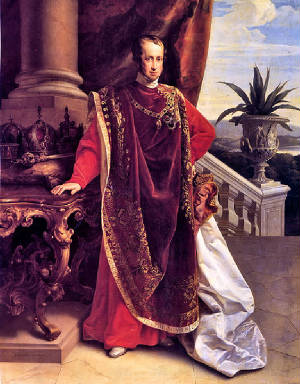 3c) FERDINAND I
Karl Leopold Joseph Franz Marcelin, Emperor of Austria from the death of his father until his abdication 2 Dec 1848 (Vienna
19 Apr 1793-Prague 29 Jun 1875); m.Vienna 27 Feb 1831 Maria Anna Pss of Savoy (Rome 19 Sep 1803-Prague 4 May 1884)
4c) Marie Caroline Leopoldine
Franziska Theresia Josepha Medarde (Vienna 8 Jun 1794-Vienna 16 Mar 1795)
5c) Caroline Ludovika Leopoldine (Vienna
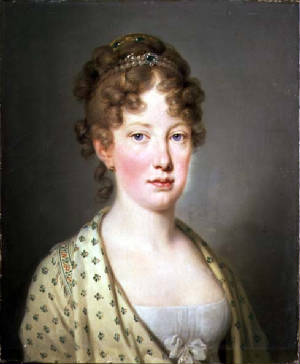
9 Dec 1795-Schloß Hetzendorf 30 Jun 1799) 6c) Maria Leopoldina Josepha Caroline (Vienna 22 Jan 1797-Rio de Janeiro 11 Dec 1826); m.by proxy at Vienna 13 May
1817 and in person at Rio de Janeiro 5 Nov 1817 Pedro I, Emperor of Brazil [later, King Pedro IV of Portugal (Queluz 12 Oct
1798-Queluz 24 Sep 1834) 7c) Marie Clementine Franziska Josepha (Vienna 1 Mar 1798-Château de Chantilly 3 Sep 1881); m.Schönbrunn
28 Jul 1816 Leopoldo Pr of Bourbon-Two Sicilies, Pr di Salerno (Naples 2 Jul 1790-Naples 10 Mar 1851)
8c)
Joseph Franz Leopold (Vienna 9 Apr 1799-Laxenburg 30 Jun 1807) 9c) Marie Caroline Ferdinande Theresia Josephine Demetria (Vienna 8 Apr 1801-Dresden 22 May 1832); m.by proxy at
Vienna 26 Sep 1819 and in person at Dresden 7 Oct 1819 King Friedrich August II of Saxony (Dresden 18 May 1797-Brennbuchel
9 Aug 1854. 10c) Franz Karl Joseph (Vienna 7 Dec 1802-Vienna 8 Mar 1878); he renounced his succession rights 1848;
m.Vienna 4 Nov 1824 Sophie Pss of Bavaria (Munich 27 Jan 1805-Vienna 28 May 1872)  1d) FRANZ JOSEPH Karl,
Emperor of Austria 2 Dec 1848 (Schönbrunn 18 Aug 1830-Schönbrunn 21 Nov 1916); m.Vienna 24 Apr 1854 Elisabeth Dss
in Bavaria (Munich 24 Dec 1837-assassinated at Geneva 10 Sep 1898) . 1e) Sophie Friederike Dorothea Maria Josepha (Vienna 5 Mar 1855-Buda 29 May 1857) 2e) Gisela
Louise Marie (Laxenburg 12 Jul 1856-Munich 27 Jul 1932); m.Vienna 20 Apr 1875 Leopold Pr of Bavaria (Munich 9 Feb 1846-Munich
28 Sep 1930) 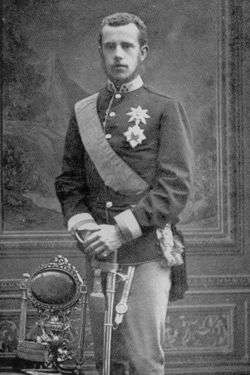
3e) Rudolf Franz Karl Joseph, Crown
Prince of Austria (Laxenburg 21 Aug 1858-committed suicide at Mayerling 30 Jan 1889); m.Vienna 10 May 1881 Stephanie Pss of
Belgium (Laeken 21 May 1864-Pannonhalma, Hungary 23 Aug 1945) 1f) Elisabeth Marie Henriette
Stephanie Gisela (Laxenburg 2 Sep 1883- Vienna-Hütteldorf 22 Mar 1963); m.1st Vienna 23 Jan 1902 (div 1924) Otto Pr zu
Windisch-Grätz (Graz 7 Oct 1873-Lugano 25 Dec 1952); m.2d Vienna 4 May 1948 Leopold Petznek (Bruck an der Leitha 30 Jun
1881-Vienna 27 Jul 1956) 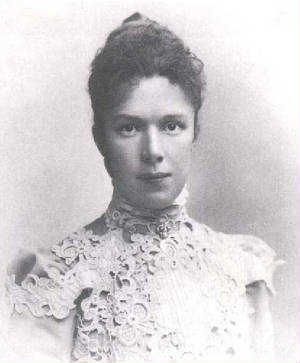 4e) Marie Valerie Mathilde Amalie (Buda 22 Apr 1868-Schloß
Wallsee 6 Sep 1924); m.Ischl 31 Jul 1890 Franz Salvator Archduke of Austria (Altmünster 21 Aug 1866-Vienna 20 Apr 1939) 2d) Ferdinand Maximilian, b.Vienna 6 Jul
1832, became Emperor Maximilian of Mexico 10 Apr 1864 but was ousted by revolutionaries and executed at Queretaro, Mexico
19 Jun 1867; m.Brussels 27 Jul 1857 Charlotte Pss of Belgium (Laeken 7 Jun 1840-Château de Bouchout, Belgium 19 Jan
1927) 3d) Karl Ludwig (Schönbrunn 30 Jul 1833-Vienna 19 May 1896); m.1st Dresden 4 Nov 1856
Margaretha Pss of Saxony (Dresden 24 May 1840-Monza 15 Sep 1858); m.2d by proxy at Rome 16 Oct 1862 and in person at Venice
21 Oct 1862 Maria Annunciata Pss of Bourbon-Two Sicilies (Caserta 24 Mar 1843-Vienna 4 May 1871); m.3d Kleinheubach 23 Jul
1873 Maria Teresa Infanta of Portugal (Kleinheubach 24 Aug 1855-Vienna 12 Feb 1944) . 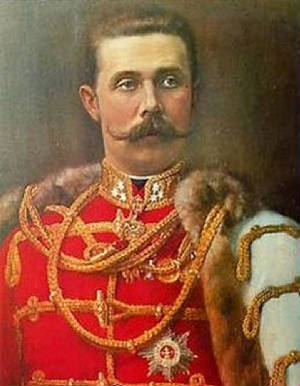 1e) Franz Ferdinand Karl Ludwig Joseph, who became heir presumptive to the Imperial Throne on the death of his cousin,
the Crown Prince Rudolf, in 1889 (Graz 18 Dec 1863-assassinated at Sarajevo 28 Jun 1914); m.(morganatically) at Reichstadt,
Bohemia 1 Jul 1900 Sophie Gfn Chotek von Chotkowa, who was in 1905 cr Herzogin von Hohenberg (Durchlaucht) (Stuttgart 1 Mar
1868-assassinated at Sarajevo 28 Jun 1914); their issue bear the titles Fürst[in] von Hohenberg (Durchlaucht), except
the head of the house, who is Herzog von Hohenberg 1f) Sophie Marie Franziska Antonia Ignatia Alberta (Konopischt 24
Jul 1901-Thannhausen 27 Oct 1990); m.Tetschen 8 Sep 1920 Friedrich Gf von Nostitz-Rieneck (Prague 1 Nov 1893-Graz 29 Dec 1973)
see: Dukes of Hohenberg - House of Hohenberg 2e) Otto Franz Joseph Karl Ludwig Maria (Graz 21 Apr 1865-Vienna 1 Nov 1906); m.Dresden 2 Oct 1886 Maria Josepha
Pss of Saxony (Dresden 31 May 1867-Schloß Wildenwart, Upper Bavaria 28 May 1944) 1f) KARL, Emperor of Austria on the death of his great-uncle, Emperor Franz Josef, in 1916, until he fled
the country in 1918/9; b.Persenbeug 17 Aug 1887, d.Funchal, Madeira 1 Apr 1922; m.Schwarzau am Steinfelde 21 Oct 1911 Zita
Pss of Bourbon-Parma (Villa Pianore 9 May 1892-Zizers 14 Mar 1989) 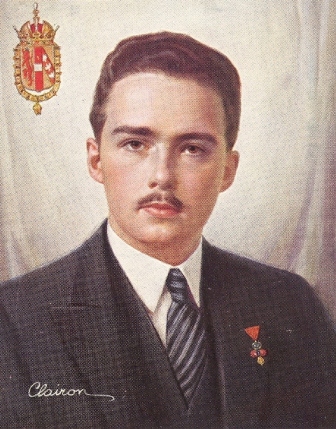 1g) Franz Joseph OTTO Robert
Maria Anton Karl Max Heinrich Sixtus Xaver Felix Renatus Ludwig Gaetan Pius Ignatius, relinquished status as head of house
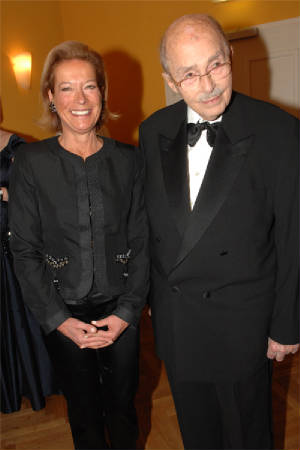
to his son Karl 2007 (Villa Wartholz bei Reichenau, Lower Austria 20 Nov 1912-Pöcking 4 Jul 2011); m.Nancy 10 May 1951
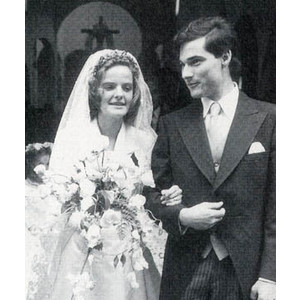
Regina Pss of Saxe-Meiningen (Würzburg 6 Jan 1925-Pöcking 3 Feb 2010) 1h) Andrea Maria, b.Würzburg 30 May 1953; m.(civ) Pöcking, Upper Bavaria 9 Jul
1977 (rel) 30 Jul 1977 Karl Eugen Erbgf von Neipperg (b.Schwaigern 20 Oct 1951) 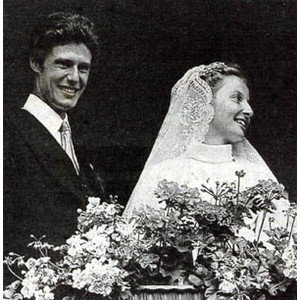 2h)
Monika Maria Roberta Antonia Raphaela, b.Würzburg 13 Sep 1954; m.Pöcking 21 Jun 1980 Don Luis Gonzaga de Casanova-Cárdenas
y Barón Duque de Santangelo Marqués de Elche Cde de Lodosa (b.Madrid 24 Apr 1950) 3h) Michaela Maria Madeleine Kiliana Elisabeth, b.Würzburg 13 Sep 1954; m.1st (civ) 12 Jul 1982 (rel)
Anton, Panama 14 Jan 1984 (div 1993) Eric Alba Teran d'Antin (Mexico City 21 May 1920-New York 9 Jul 2004 [acc to internet
reports, not confirmed); m.2d 22 Oct 1994 (div 1998) Hubertus Gf von Kageneck (b.Haus Blumenscheidt bei Wittlich 10 Aug 1940) 4h) Gabriela Maria Charlotte Felicitas Elisabeth Antonia, b.Luxemburg 14 Oct 1956; m.(civ)
Pöcking 30 Aug 1978 (rel) St.Odile 5 Sep 1978 (div 1997) Christian Meister (b.Starnberg 1 Sep 1954) 5h) Walburga Maria Franziska Helene Elisabeth, b.Berg am Starnberger See 5 Oct 1958; m.Budapest
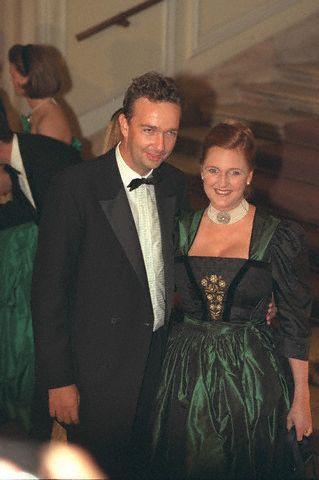
5 Dec 1992 Carl Axel Archibald Gf Douglas (b.Stockholm 27 Nov 1949) 6h) KARL Thomas Robert Maria
Franziskus Georg Bahnam, b.Starnberg 11 Jan 1961; m.Mariazell 31 Jan 1993 (civ) Salzburg 6 Feb 1993 Bss Francesca von Thyssen-Bornemisza
(b.Lausanne 7 Jun 1958) 1i) Eleonore Jelena Maria del Pilar Iona, b.Salzburg
28 Feb 1994
2i) Ferdinand Zvonimir Maria Balthus Keith Michal Otto
Antal Bahnam Leonhard, b.Salzburg 21 Jun 1997
3i) Gloria Maria
Bogdana Paloma Regina Fiona Gabriela, b.Salzburg 15 Oct 1999
|