|
Ottoman
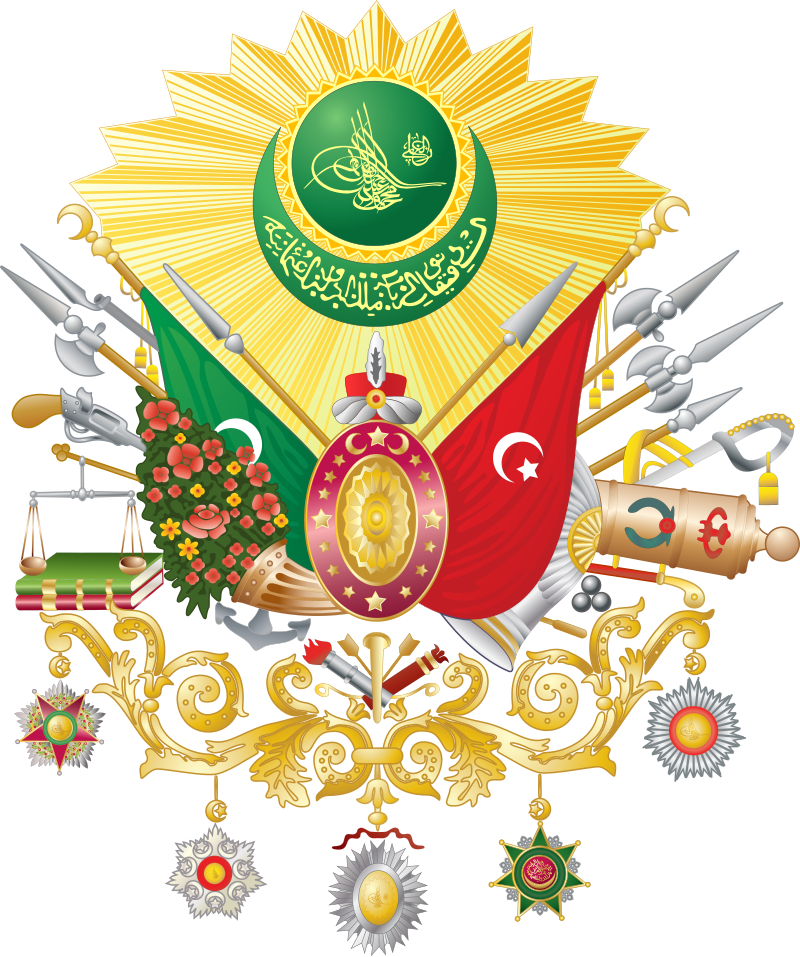
Empire Devlet-i Aliye-yi Osmaniyye The Ottoman Empire or Sublime Ottoman State (Ottoman Turkish:
دَوْلَتِ عَلِيّهٔ عُثمَانِیّه
Devlet-i ʿAliyye-yi ʿOsmâniyye (also عثمانلى دولتى
Osmanlı Devleti), Modern Turkish: Osmanlı Devleti or Osmanlı İmparatorluğu) was a Turkish empire
which lasted from 27 July 1299 to 29 October 1923. 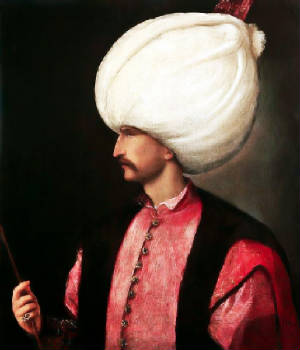 The
Ottoman Empire was one of the largest and longest lasting empires in history; such that the Ottoman State, its politics, conflicts,
and cultural heritage in a vast geography provide one of the longest continuous narratives. During the 16th and 17th centuries,
in particular at the height of its power under the reign of Suleiman the Magnificent, the empire became the most powerful
state in the world - a multinational, multilingual empire that stretched from the southern borders of the Holy Roman Empire
to the outskirts of Vienna, Royal Hungary (modern Slovakia) and the Polish-Lithuanian Commonwealth in the north to Yemen and
Eritrea in the south; from Algeria in the west to Azerbaijan in the east; controlling much of southeast Europe, Western Asia
and North Africa. The empire contained 29 provinces and numerous vassal states, some of which were later absorbed into the
empire, while others were granted various types of autonomy during the course of centuries. 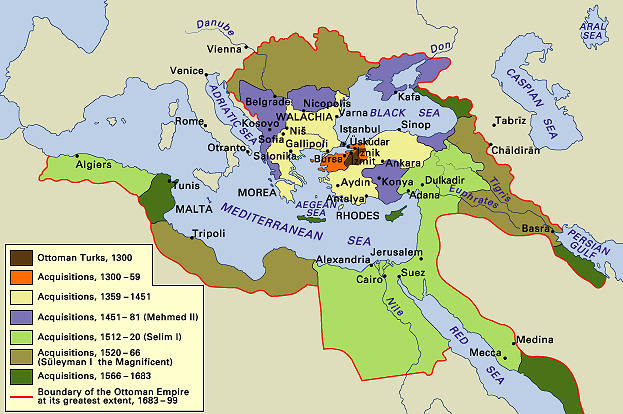
With
Constantinople (present-day Istanbul, Ottoman Turkish: استنبول, Istanbul and قسطنطينيه,
Kostantiniyye) as its capital city, and vast control of lands around the Mediterranean basin, the empire was at the center
of interactions between the Eastern and Western worlds for over six centuries. After the international recognition of the Grand National Assembly of Turkey (GNAT) headquartered in Ankara,
by means of the Treaty of Lausanne signed on 24 July 1923, the GNAT proclaimed on 29 October 1923 the establishment of the
Republic of Turkey as the new Turkish State that succeeded and formally ended the defunct Ottoman Empire, in line with the
treaty. The Ottoman Caliphate was abolished on 3 March 1924 (de jure, the Caliphate's powers and properties were transferred
to the GNAT.) 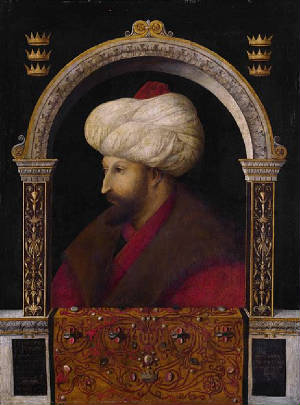
The
Imperial House of Osman- Osmanoglu The Osmanli Dynasty traces its origins to Osman Khan Ghazi, founder of the Turkish Empire
and son of Ertugrul, leader of the Kayi clan of the Oghuz tribe, during the late 13th century. The tribe reputedly descends
from Noah, through his grandson, Oghuz. The Imperial
Ottoman family ruled the Ottoman Empire from 1299 until the establishment of the Republic of Turkey in 1922. The rule of one
single family, for more than 600 years, over an Empire that was once the most powerful in the world is unique in world history.
There were thirty six Ottoman Sultans who ruled over the Empire, and each one was a direct descendant through the male line
of the first Ottoman Sultan, Sultan Osman I. The Ottoman
dynasty is known in Turkish as Osmanlı, meaning "House of Osman". The first rulers of the dynasty never
had called themselves sultans, but rather beys, or "chieftain", roughly the Turkic equivalent of Emir,
which would itself become a gubernatorial title and even a common military or honorific rank. Thus they still formally
acknowledged the sovereignty of the contemporary Seljuk Sultanate of Rûm and its successor, the Ilkhanate. 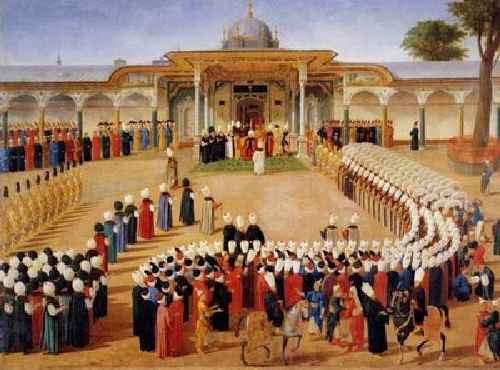 The first Ottoman to actually claim the title of sultân
was Murad I, who
ruled from 1359 to 1389. The title sultan (سلطان)-in Arabic, was in later Arabic-Islamic
dynasties originally the power behind the throne of the Caliph in Bagdad and it was later used for various independent Muslim Monarchs.
This title was more prestigious then Emir; it was not comparable to the title of Malik 'king' or the originally Persian title
of Shah. With the Conquest of Constantinople in 1453, the road was open for the Ottoman state to become an empire, with Sultan Mehmed II taking
the title of pâdişah (پادشاه), a Persian title meaning "lord of kings" claiming
superiority to the other kings, that title was abandoned when the empire declined and lost its might. In addition to such secular
titles, the Ottoman sultan became the Caliph of Islam, starting with Selim I,
who became khalif after the death of the last Abbasid Caliph Al-Mutawakkil III, the last of Abbasid Caliphs in Cair. After the deposition of the last Sultan, Mehmet VI, in 1922, and the subsequent abolition
of the Ottoman Caliphate in 1924, members of the Imperial family were forced into exile. Their descendants now live in many
different countries throughout Europe, as well as in the USA, the Middle East, and since they have now been permitted to return
to their homeland, many now also live in Turkey. When in exile, the family adopted the surname of Osmanoğlu, meaning
son of Osman, out of respect for the founder of their dynasty. It was announced in 2010 that members of the Ottoman dynasty
are working to create a foundation with the goal of uniting the family and helping the ones living abroad to connect with
their Turkish heritage. 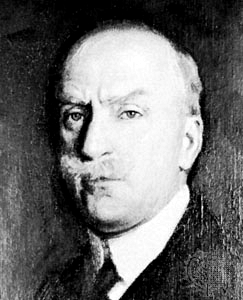
Heads
of the House of Osman since 1922 The Ottoman dynasty was exiled from Turkey in 1924. The female members of the
dynasty were allowed to return after 1951, and the male members after 1973. Below is a list of people who would have been heirs to the Ottoman throne following the abolition of the sultanate
on 1 November 1922. These people have not necessarily made any claim to the throne; for example Ertuğrul
Osman said "Democracy works well in Turkey." - Mehmed VI, last Ottoman Sultan (1918-1922) then 36th Head of the House of Osman in exile
(1922-1926).
- Abdülmecid II, last
Ottoman Caliph (1922-1924) then 37th Head of the House of Osman following Mehmed VI's death (1926-1944).
- Ahmed IV Nihad, 38th Head of the House of Osman (1944-1954), grandson
of Sultan Murad V.
- Osman IV Fuad,
39th Head of the House of Osman (1954-1973), brother of Ahmed IV Nihad, and grandson of SultanMurad V.
- (Mehmed) Abdülaziz II, 40th Head of the House of Osman (1973-1977),
grandson of Sultan Abdülaziz I.
- Ali
I Vâsib, 41st Head of the House of Osman (1977-1983), son of Ahmed IV Nihad, and great-grandson of Sultan Murad
V.
- (Mehmed) Orhan II, 42nd Head of
the House of Osman (1983-1994), grandson of Sultan Abdul Hamid II.
- Ertuğrul Osman V, 43rd Head of the House of Osman (1994-2009), grandson of Sultan Abdul
Hamid II.
- (Osman) Bayezid III, 44th
Head of the House of Osman (2009-present), great-grandson of Sultan Abdülmecid I.
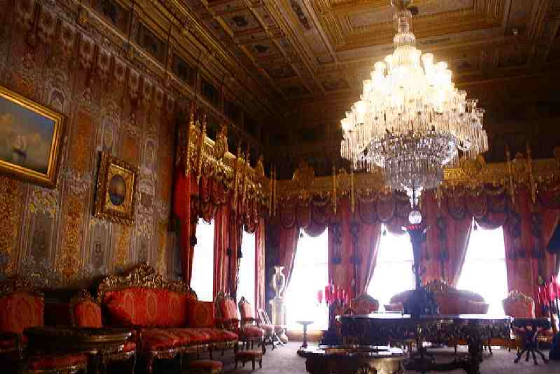 Resurgence of interest in the Ottoman Dynasty Since the turn of this century there has been a growing interest
in the living members of the Ottoman family, both within Turkey and abroad. In 2006, family members met at Dolmabahçe Palace for
the presentation of the documentary "Osmanoğlu'nun Exile" produced by TRT (Turkish Radio and Television Corporation). This documentary followed the stories of the members of the Ottoman family who went into
exile in 1924, following the establishment of the Turkish Republic and the abolition of the Ottoman Caliphate. It then follows
the stories of their descendants, who now live in Turkey, Europe, the United States and throughout the Middle East. Extensive
coverage of this event, and the success of the documentary series has dramatically raised the profile of the Imperial Family. The outpouring of affection shown by the Turkish people at the funeral
of H.I.H Prince Ertuğrul Osman Efendi in September 2009 revealed how deep feeling still runs for the Imperial
family. 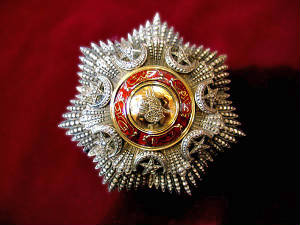
Turkish CitizenshipWithout any exception, all members
of the Imperial Ottoman family were exiled in 1924. Most had never left their homeland before, and all were forced to make
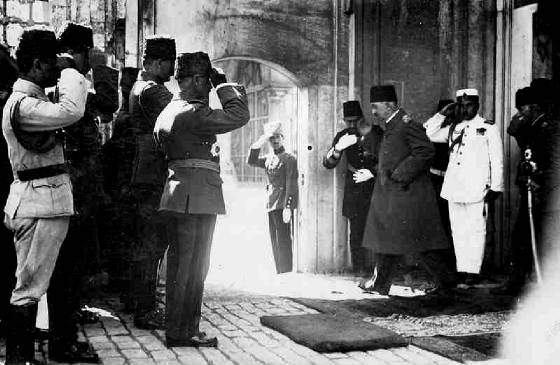
a new life abroad. The family departed from Sirkeci Train Station, and would disperse across Europe, the United
States and the Middle East. As the former Ottoman Sultan, H.I.M. Sultan Mehmed VI Vahideddin, had settled in San
Remo, many members of the family congregated to the South of France. After living in Switzerland for a short time, the last
Caliph of Islam H.I.H. Prince (Şehzade) Abdulmecid II, also moved to Nice. The travel documents issued by the Turkish
Republic to the Ottoman family on their exile were only valid for one year. Therefore, by 1925 members of the family were
no longer able to travel, and it was due to the intervention of H.I.H. Prince (Şehzade) Ali Vâsib Efendi
that the family received courtesy passports from the French Government. The French Government also issued passports to the
children of the members of the family who were born in exile. Today many members of the Ottoman family have now obtained Turkish
citizenship, and hold Turkish passports. 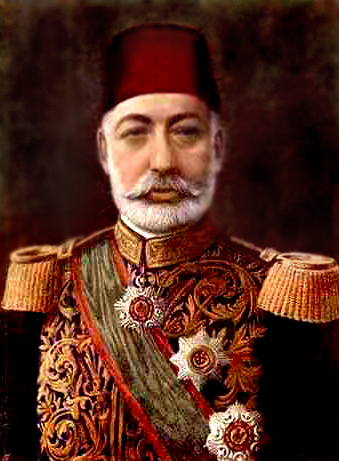
Imperial Princes (Şehzades) of the House of Osman The formal way of addressing the male descendants
of the Ottoman Sultans is Daulatlu Najabatlu Şehzade (given name) Hazretleri Efendi, i.e. Prince (given name) Efendi,
with the style of His Imperial Highness. According to genealogies of the House of Osman, had the Sultanate not been abolished,
there are twenty-four Imperial Princes in the line of succession after Bayezid Osman, the current head of the family. They
are listed as follows; the succession law used is agnatic seniority, with the succession passing to eldest
male dynast. - HIH Prince Şehzade Dündar
Aliosman Efendi (b. 1930) (descendant of Abdul Hamid II)
- HIH Prince Şehzade Harun Osmanoğlu Efendi (b. 1932) (descendant of Abdul Hamid
II)
- HIH Prince Şehzade Cengiz
Nazim Efendi (b. 1939) (descendant of Mehmed V)
- HIH
Prince Şehzade Osman Selaheddin Osmanoğlu Efendi (b. 1940) (descendant of Murad V through Ahmed
IV and Ali I, and of Mehmed V through Ömer Hilmi)
- HIH Prince Şehzade Ömer Abdülmecid Osmanoğlu Efendi
(b. 1941) (descendant of Mehmed V through Ömer Hilmi andMahmud Namık)
- HIH Prince Şehzade Mehmed Selim Orhan Efendi (1943) Abdul
Hamid II)
- HIH Prince Şehzade
Mehmed Ziyaeddin Efendi (b. 1947) (descendant of Mehmed V)
- HIH Prince Şehzade Roland Selim Kadir Efendi (b. 1949) (descendant of Abdul Hamid II)
- HIH Prince Şehzade Selim Djem Efendi (b. 1955) (descendant
of Abdülmecid I)
- HIH Prince
Şehzade Orhan İbrahim Suleiman Saadeddin Efendi (b. 1959) (descendant of Abdülaziz I)
- HIH Prince Şehzade Orhan Osmanoğlu Efendi (b. 1963) (descendant
of Abdul Hamid II)
- HIH Prince
Şehzade Eric Mehmed Ziyaeddin Nazim Efendi (b. 1966) (descendant of Mehmed V)
- HIH Prince Şehzade Orhan Murad Osmanoğlu Efendi (b. 1972) (descendant
of Murad V through Ahmed IV and Ali I, and of Mehmed V through Ömer Hilmi)
- HIH Prince Şehzade Francis Mahmud Namık Osmanoğlu Efendi
(b. 1975) (descendant of Mehmed V through Ömer Hilmiand Mahmud Namık)
- HIH Prince Şehzade René Osman Abdul Kadir Efendi (b.
1975) (descendant of Abdul Hamid II)
- HIH
Prince Şehzade Daniel Adrian Hamid Kadir Efendi (b. 1977) (descendant of Abdul Hamid II)
- HIH Prince Şehzade Abdulhamid Kayıhan Osmanoğlu Efendi
(b. 1979) (descendant of Abdul Hamid II)
- HIH
Prince Şehzade Selim Süleyman Osmanoğlu Efendi (b. 1979) (descendant of Murad V through Ahmed
IV and Ali I, and of Mehmed V through Ömer Hilmi)
- HIH Prince Şehzade Nazım Osmanoğlu Efendi (b. 1985) (descendant
of Mehmed V)
- HIH Prince Şehzade
Yavuz Selim Osmanoğlu Efendi (b. 1989) (descendant of Abdul Hamid II)
- HIH Prince Şehzade Turan Cem Osmanoğlu Efendi (b. 2004) (descendant of Murad
V through Ahmed IV and Ali I)
- HIH
Prince Şehzade Tamer Nihad Osmanoğlu Efendi (b. 2006) (descendant of Murad V through Ahmed IV and Ali
I)
- HIH Prince Şehzade Harun Osmanoğlu
Efendi (b. 2007) (descendant of Abdul Hamid II)
- HIH
Prince Şehzade Batu Bayezid Osmanoğlu Efendi (b. 2008) (descendant of Murad V through Ahmed IV and Ali
I)
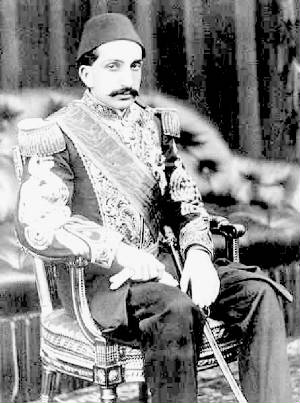 Imperial Princesses
(Sultans) of the House of Osman The formal way of addressing the female descendants of the Ottoman Sultans is Daulatlu Hazretleri
(given name) Sultan, i.e. Princess (given name) Sultan, with the style of Her Imperial Highness. According to genealogies
of the House of Osman, had the Sultanate not been abolished, there are seventeen Imperial Princesses. - HIH Princess Fatma Neslişah Sultan (b. 1921) (descendant
of Caliph Abdülmecid II, and of Mehmed V)• Children: Sultanzade HRH Prince Abbas Hilmi Beyefendi 1941,
HRH Princess İkbal Hanımsultan 1944
- HIH
Princess Safvet Neslişah Sultan (b. 1925) (descendant of Mehmed V) • Children: Sultanzade HH Prince Salih
Beyefendi 1955, Sultanzade HH Prince Ömer Beyefendi 1959
- HIH Princess Fevziye Sultan (b. 1928) (descendant of Mehmed V)
- HIH Princess Fatma Necla Sultan (b. 1933) (descendant of Mehmed
V) • Children: Sultanzade HH Prince Mehmed Erol Beyefendi 1954, Sultanzade HH Prince Osman Cem Beyefendi 1963
- HIH Princess Margot Leyla Sultan (b. 1947) (descendant of Mehmed
V) • Children: HH Princess Katharina Alia Hanımsultan 1980
- HIH Princess Iskra Sultan (b. 1949) (descendant of Mehmed V) • Child: HH Princess Andrea Hanımsultan 1974
- HIH Princess Nilüfer Sultan (b. 1953) (descendant of Mehmed V)
- HIH Princess Perihan Sultan (b. 1963) (descendant of Abdülaziz)
- HIH Princess Ayşe Louise Sultan (b. 1964) (descendant of Mehmed
V)[• Children: HH Princess Peri Kathleen Hanımsultan 1994, Sultanzade HH Prince Zekeriya James Beyefendi
1996
- HIH Princess Gülhan Sultan
(b. 1968) (descendant of Abdülaziz)
- HIH
Princess Ayşe Gülnev Sultan (b. 1971) (descendant of Murad V through Ahmed IV and Ali I,
and of Mehmed Vthrough Ömer Hilmi)• Children: Sultanzade HH Prince Maximilian Ali Beyefendi 2000, Sultanzade
HH Prince Cosmo Tarık Beyefendi 2001, Sultanzade HH Prince Lysander Cengiz Beyefendi 2003, HH Princess Tatyana Aliye
Hanımsultan 2005, Sultanzade HH Prince Ferdinand Ziya Beyefendi 2006
- HIH Princess Nurhan Sultan (b. 1973) • Children: Sultanzade HH Prince Muhammed Halil
Beyefendi 2002, HH Princess Sara Hanımsultan 2004
- HIH
Princess Nilhan Sultan (b. 1987) (descendant of Abdul Hamid II)
- HIH Princess Nermin Zoe Sultan (b. 1988) (descendant of Mehmed V)
- HIH Princess Nilüfer Sultan (b. 1995) (descendant of Mehmed
V)
- HIH Princess Berna Sultan (b. 1998)
(descendant of Abdul Hamid II)
- HIH
Princess Asyahan Sultan (b. 2004) (descendant of Abdul Hamid II)
 Biographies of Members of the House of Osman 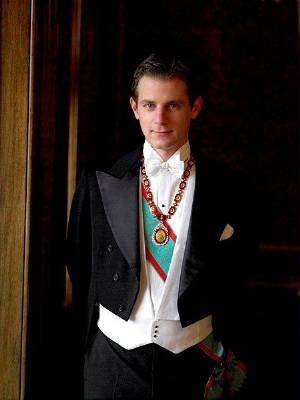 H.I.H. Prince
Orhan Murad Efendi Orhan Murad Osmanoğlu (H.I.H. Prince (Şehzade) Orhan Murad Efendi) born in Henley-on-Thames,
Oxon, England on 26 December 1972, eldest son of H.I.H. Prince (Şehzade) Osman Selaheddin Osmanoğlu and his wife
H.H. Athena Joy Hanımefendi. (b. at London, 9 March 1944), née, Christoforides. He is the great-great-great-grand-son
of H.I.M. Sultan Murad V, 33rd Sovereign of the House of Osman through his grandfather H.I.H. Prince (Şehzade) Ali Vasıb
Efendi, 41st Head of the Imperial House of Osman, and also the great-great-grand-son of H.I.M. Sultan Mehmed V Reşad
Han Gazi, 35th Sovereign of the House of Osman, through his grandmother H.I.H. Princess Emine Mükbile Sultan. His father
H.I.H. Prince (Şehzade) Osman Selaheddin Efendi, is the only Ottoman prince whose parents are both descendants of the
Imperial Ottoman dynasty. educ. Degree in Business and Economics at Kingston Univ. H.I.H. Prince (Şehzade) Orhan
Murad Efendi lives in Buckinghamshire with his family, and works for a property investment and development company. Prince Orhan married on 17 February 2000, H.H. Patricia Emine
Hanımefendi née, Iotti, and has issue, two sons: H.I.H. Prince (Şehzade) Turan Cem Efendi. born at High Wycombe, England, 7 January
2004
H.I.H. Prince
(Şehzade) Tamer Nihad Efendi. born at High Wycombe, England, 15 April 2006. H.I.H. Prince Selim Süleyman Osmanoğlu
Efendi
H.I.H. Prince (Şehzade) Selim Süleyman Osmanoğlu Efendi. born at High Wycombe, England ,
15 December 1979. educ. Degree in Business Studies at Kingston University, London and Fellow of the Chartered Institute of
Insurance, a Chartered Insurance Broker and a Member of the Institute of Risk Management. m. at İstanbul, 22 June 2003,
H.H. Alev Hanımefendi, née, Öcal. educ. Boğaziçi University, İstanbul. He has issue, one
son: i) H.I.H. Prince (Şehzade) Batu Bayezid Efendi. born at Sidcup, England, 23 April 2008. 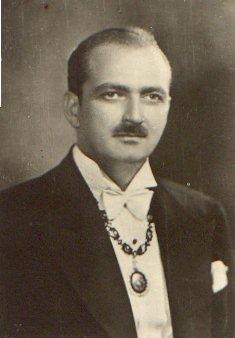 H.I.H. Prince
Mahmud Namık Efendi Prince Mahmud Namık Efendi (December 23, 1913; Dolmabahçe Palace-), is the only son of Prince
Ömer Hilmi Efendi, and his wife H.H. Hadice Firdevs Gülnev Başhanımefendi, and grand-son of Sultan Mehmed
V. He received the Collar of the Hanedan-ı-Ali-Osman. Mahmud
Namık Effendi was born in Dolmabahçe Palace and lived there until the death of his grandfather, Sultan Mehmed
V, just before the end of World War I on July 4, 1918. He then moved with his family to a Konak (residence) at Nişantaşı
for the winter months and to one in Bağlarbaşı, above Beylerbeyi, for the summer. Following the establishment
of the Republic of Turkey and the abolition of the Ottoman Sultanate and the Ottoman Caliphate, the entire Imperial Ottoman
family were forced into exile in March 1924. Mahmud Namık left his homeland at the age of 10, never to return to Turkey,
since he died before the decree of exile was lifted. He was initially sent to boarding school in Lebanon, but then soon came
to live with his family in Nice, France once they had settled there to be close to the former Ottoman Sultan Mehmed VI, who
had rented a villa in San Remo, and to their cousin the last Caliph of Islam Abdülmecid II, who lived in Nice. In 1934
he moved to Alexandria, Egypt with his father, Prince Ömer Hilmi Efendi, and grandmother, and was later joined in January
by his sister, Princess Emine Mükbile, and his brother-in-law, Prince Ali Vâsib Efendi. He worked until the end
of World War II for the Alexandria tramline company. In the late 1940s he established himself as a successful businessman
and settled in Geneva, Switzerland where he developed his business interests in places as far apart as Pakistan and the USA.
In 1958 he was asked to help negotiate the marriage of his cousin Princess Sabiha Fazila Hanimsultan, the only daughter of
Prince Muhammad 'Ali Ibrahim Beyefendi of Egypt and Princess Zehra Hanzade Sultan, to King Faisal II of Iraq. The engagement
was brutally brought to an end by the murder of King Faisal II, following a military coup on July 14, 1958. Mahmud Namık
had a passion for music and in particular very much enjoyed playing the Spanish guitar. He died at the age of 49 from a stroke, at Cairo, Egypt on November 13, 1963 and buried
at Khedive Tawfik Mausoleum (Cairo), then transferred to Sultan Mahmud II Mausoleum (Istanbul) in 1987. He married on August 1939
(div. at Alexandria, 1947) Şaharazade Hanımefendi (b. at Alexandria, 1922; d. 1993), only daughter of Ismail Ratib
Bey, by his wife Princess Emine Bihruz, younger daughter of Prince Ibrahim Rashid Fazil Pasha, of Egypt. They had issue, an
only son: H.I.H. Prince Ömer Abdülmecid Osmanoğlu b. at Alexandria, 4 June 1941, educ. Stowe school, Buckinghamshire,
England, and degree in Business Administration from London Univ.
H.I.H. Prince Ömer Abdülmecid Osmanoğlu H.I.H. Prince Ömer Abdülmecid
b. at Alexandria, 4 June 1941, the only child of H.I.H. Prince (Şehzade) Mahmud Namık Efendi, and his wife H.H.
Şaharazade Hanımefendi, (b. at Alexandria, 1922; d. 1993, only daughter of Ismail Ratib Bey, by his wife H.R.H.
Princess Emine Bihruz, younger daughter of H.R.H. Prince Ibrahim Raşid Fazıl Paşa, of Egypt), and great-grandson
of H.I.M. Sultan Mehmed V Reşad Han Gazi , 35th Sovereign of the House of Osman. educ. Stowe School, Buckinghamshire,
England, and degree in Business Administration from London Univ. m. Beulah Hanımefendi (b. 8 April 1943), née Banbury. He has issue, an only son: H.I.H. Prince (Şehzade)
Mahmud Namık Osmanoğlu born in London, 27 April 1975, educ. MFA in Design and Technology from Parsons The New School
for Design, New York City, USA. He is a co-founder and director of Streaming Well an online health channel, he lives in England.
H.I.H.
Prince (Şehzade) Ömer Abdülmecid Efendi had a career as an oil trader in the City of London, is an accomplished
chess player and is now retired and lives in Sussex, England. 
H.I.H.
Prince Mahmud Francis Namık Efendi H.I.H. Prince Mahmud Francis Namık Efendi was born in London at what is now the Lanesborough
Hotel on 27 April 1975. He is the only child of H.I.H. Prince (Şehzade) Ömer Abdülmecid Osmanoğlu Efendi,
and Beulah Hanımefendi, née Banbury, and great-great grandson of H.I.M. Sultan Mehmed V Reşad Han Gazi ,
35th Sovereign of the House of Osman. Prince Mahmud earned an MFA in Design and Technology from Parsons The New School for
Design, New York City, USA and a BFA in Visual Communications from Parsons Paris School of Art and Design, Paris, France.
He is a co-founder and director of Streaming Well an online health channel, he lives in England. He attended Gulliver Preparatory
High School in Miami Florida, and The Mougins School, in the South of France (Riviera). He is an accomplished drummer with
rock group The Janitors and they released their first LP "Sweeping the Nation" in 2010. He is also an avid tennis
player. Prince Mahmud Efendi was the subject of an interview
by the Anatolian News Agency which was picked up for publication in a number of outlets in both Turkey and the UK. A Sultan's
descendant in the heart of London. 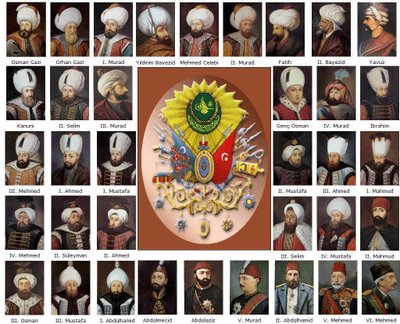
List
of Sultans of the Ottoman Empire The table below lists Ottoman sultans, as well as the last Ottoman caliph, in chronological
order. The "Notes" column contains information on each sultan's parentage and fate. When a sultan's reign did not
end through a natural death, the reason is indicated in bold. For earlier rulers, there is usually a time gap between the
moment a sultan's reign ended and the moment his successor was enthroned. This is because the Ottomans in that era practiced
what historian Quataert has described as "survival of the fittest, not eldest, son": when a sultan died, his sons
had to fight each other for the throne until a victor emerged. Because of the infighting and numerous fratricides that occurred,
a sultan's death date therefore did not always coincide with the accession date of his successor. In 1617, the law of succession
changed from survival of the fittest to a system based on agnatic seniority (ekberiyet), whereby the throne went to the oldest
male of the family. This in turn explains why from the 17th century onwards a deceased sultan was rarely succeeded by his
own son, but usually by an uncle or brother. Agnatic seniority was retained until the abolition of the sultanate, despite
unsuccessful attempts in the 19th century to replace it with primogeniture. 
|