|
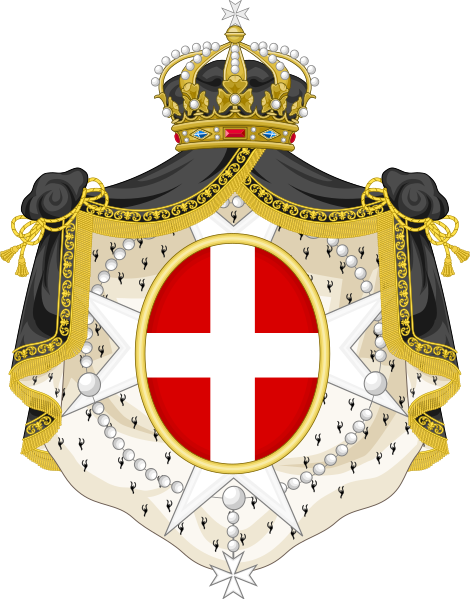 The Sovereign Military Hospitaller Order of Saint John of Jerusalem of Rhodes
and of Malta (Italian: Sovrano Militare Ordine Ospedaliero di San Giovanni di Gerusalemme di Rodi e di Malta), also
known as the Sovereign Military Order of Malta (SMOM), Order of Malta or
Knights of Malta, is a Roman Catholic lay religious order, traditionally of military, chivalrous, noble nature.
It is the world's oldest surviving order of chivalry. The Sovereign Military Order of Malta is headquartered in Rome,
and is widely considered a sovereign subject of international law. SMOM is the modern continuation of the original medieval order of Saint John of Jerusalem,
known as the Knights Hospitaller, a group founded in Jerusalem about 1050 as an Amalfitan hospital to provide care for poor
and sick pilgrims to the Holy Land. After the conquest of Jerusalem in 1099 during the First Crusade, it became a military
order under its own charter. Following the loss of Christian held territories of the Holy Land to Muslims, the Order operated
from Rhodes (1310-1523), and later from Malta (1530-1798), over which it was sovereign. Although this state came to an end
with the ejection of the Order from Malta by Napoleon, the Order as such survived. It retains its claims of sovereignty under
international law and has been granted permanent observer status at the United Nations. Today the order has about 13,000 members; 80,000 permanent volunteers;
and 20,000 medical personnel including doctors, nurses, auxiliaries and paramedics in more than 120 countries.[3]
The goal is to assist the elderly, handicapped, refugeed, children, homeless, those with terminal illness and leprosy in
five continents of the world, without distinction of race or religion. In several countries-including France, Germany and
Ireland-the local associations of the Order are important providers of first aid training, first aid services and emergency
medical services. Through its worldwide relief corps-Malteser International-the Order is also engaged to aid victims of natural
disasters, epidemics and armed conflicts. Name and insignia
The Order has a large number of local priories
and associations around the world but there also exist a number of organizations with similar-sounding names that are unrelated,
including numerous fraudulent (self-styled) orders seeking to capitalize on the name. In the ecclesiastical heraldry of the Roman Catholic Church, the
Order of Malta is one of only two orders (along with the Order of the Holy Sepulchre) whose insignia may be displayed in a
clerical coat of arms. (Laypersons have no such restriction.) The shield is surrounded with a silver rosary for professed
knights, or for others the ribbon of their rank. Members may also display the Maltese Cross behind their shield instead of
the ribbon. History
The birth of the Order dates back to around
1048. Merchants from the ancient Marine Republic of Amalfi obtained from the Caliph of Egypt the authorisation to build
a church, convent and hospital in Jerusalem, to care for pilgrims of any religious faith or race. The Order of St.John of
Jerusalem - the monastic community that ran the hospital for the pilgrims in the Holy Land - became independent under the
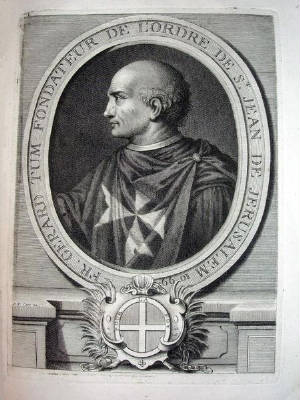
guidance of its founder, Blessed Gérard. With the Bull of 15 February 1113, Pope Paschal II approved the foundation
of the Hospital and placed it under the aegis of the Holy See, granting it the right to freely elect its superiors without
interference from other secular or religious authorities. By virtue of the Papal Bull, the Hospital became an Order exempt
from the Church. All the Knights were religious, bound by the three monastic vows of poverty, chastity and obedience.
The constitution of the Kingdom of Jerusalem
regarding the crusades obliged the Order to take on the military defence of the sick, the pilgrims and the territories that
the crusaders had conquered from the Muslims. The Order thus added the task of defending the faith to that of its hospitaller
mission. As time went on, the Order adopted the white eight-pointed Cross that is still its symbol today.
Rhodes
When the last Christian stronghold in the
Holy Land fell in 1291, the Order settled first in Cyprus and then, in 1310, led by Grand Master Fra' Foulques de Villaret,
on the island of Rhodes. From there, defense of the Christian world required the organization of a naval force; so the Order
built a powerful fleet and sailed the eastern Mediterranean, fighting many famous battles for the sake of Christendom, including
Crusades in Syria and Egypt. In
the early 14th century, the institutions of the Order and the knights who came to Rhodes from every corner of Europe were
grouped according to the languages they spoke. The initial seven such groups, or Langues (Tongues) -- Provence,
Auvergne, France, Italy, Aragon (Navarre), England (with Scotland and Ireland), and Germany -- became eight in 1492, when
Castille and Portugal were separated from the Langue of Aragon. Each Langue included Priories or Grand Priories,
Bailiwicks, and Commanderies. The
Order was governed by its Grand Master (the Prince of Rhodes) and Council. From its beginning, independence from other nations
granted by pontifical charter and the universally recognised right to maintain and deploy armed forces constituted grounds
for the international sovereignty of the Order, which minted its own coins and maintained diplomatic relations with other
States. The senior positions of the Order were given to representatives of different Langues.
Malta
After six months of siege and fierce combat
against the fleet and army of Sultan Suleiman the Magnificent, the Knights were forced to surrender in 1523 and left Rhodes
with military honours. The Order remained without a territory of its own until 1530, when Grand Master Fra' Philippe de
Villiers de l'Isle Adam took possession of the island of Malta, granted to the Order by Emperor Charles V with the approval
of Pope Clement VII. The
Reformation which split Western Europe into Protestant and Roman Catholic states affected the Knights as well. In several
countries, including England and Scotland, the Order was disestablished. In others, including the Netherlands and the Germanies,
entire bailiwicks or commanderies (administrative divisions of the Order) experienced religious conversions. The "Johanniter
orders" are the continuations of these converted divisions in Germany, the Netherlands, Sweden, and other countries,
including the United States and South Africa. It was established that the Order should remain neutral in any war between Christian
nations.
In 1565 the Knights, led by Grand Master
Fra' Jean de la Vallette (after whom the capital of Malta, Valletta, was named), defended the island for more than three
months during the Great Siege by the Turks. The fleet of the Order, then one of the most powerful in the Mediterranean,
contributed to the ultimate destruction of the Ottoman naval power in the Battle of Lepanto in 1571.
In exile
Two hundred years later, in 1798, Napoleon
Bonaparte occupied the island for its strategic value during his Egyptian campaign. Because of the Order's Rule prohibiting
them to raise weapons against other Christians, the knights were forced to leave Malta. Although the sovereign rights of
the Order in the island of Malta had been reaffirmed by the Treaty of Amiens (1802), the Order was unable to return to Malta.
Rome
After having temporarily resided in Messina,
Catania and Ferrara, in 1834 the Order settled definitively in Rome, where it owns, with extraterritorial status, the Magistral
Palace in Via Condotti 68 and the Magistral Villa on the Aventine Hill. The original hospitaller mission became once again the main activity of the Order, growing
ever stronger during the last century, most especially because of the contribution of the activities carried out by the
Grand Priories and National Associations in so many countries around the world. Large-scale hospitaller and charitable activities
were carried out during World Wars I and II under Grand Master Fra' Ludovico Chigi Albani della Rovere (1931-1951). Under
the Grand Masters Fra' Angelo de Mojana di Cologna (1962-1988) and Fra' Andrew Bertie (1988-2008), the projects expanded until
they reached the furthermost regions of the planet. Return to Malta In 1998[12] due to an agreement made with the Maltese Government, the Order has
returned to Malta. It once again has property in Malta, but its headquarters are still in Rome. This agreement grants the
Order the exclusive use of Fort St Angelo in the town of Birgu, Malta. This agreement has a duration of 99 years.
International status
of the Order
With its unique history and unusual present
circumstances, the exact status of the Order in international law has been the subject of debate: it claims to be a traditional
example of a sovereign entity other than a state. Its two headquarters in Rome - the Palazzo Malta in Via dei Condotti 68,
where the Grand Master resides and Government Bodies meet, and the Villa Malta on the Aventine, which hosts the Grand Priory
of Rome - Fort Saint Angelo on the island of Malta, the Embassy of the Order to Holy See and the Embassy of the Order to Italy
have all been granted extraterritoriality. However, unlike the Holy See, which is sovereign over Vatican City, SMOM has had no sovereign territory
(other than Fort St Angelo in Malta and a few properties in Italy with extraterritoriality) since the loss of the island of
Malta in 1798. The United Nations does not classify it as a "non-member state" but as one of the "entities
and intergovernmental organizations having received a standing invitation to participate as observers." For instance,
while the International Telecommunication Union has granted radio identification prefixes to such quasi-sovereign jurisdictions
as the United Nations and the Palestinian Authority, SMOM has never received one. For awards purposes, amateur radio operators
consider SMOM to be a separate "entity", but stations transmitting from there use an entirely unofficial callsign,
starting with the prefix "1A". Likewise, for internet identification, the SMOM has neither sought nor been granted
a top-level domain, while Vatican City uses its own domain (.va). There are differing opinions as to whether a claim to sovereign status has been recognized.
Ian Brownlie, Helmut Steinberger, and Wilhelm Wengler are among the experts who say that the claim has not been recognized.
Even taking into account the Order's ambassadorial status among many nations, a claim to sovereign status is sometimes rejected.
The Order maintains diplomatic missions around the world and many of the states reciprocate by accrediting ambassadors to
the Order. Wengler-a
German professor of international law-addresses this point in his book Völkerrecht, and rejects the notion
that recognition of the Order by some states can make it a subject of international law. Conversely, professor Rebecca Wallace
-writing more recently in her book International Law-explains that a sovereign entity does not have to be a country,
and that SMOM is an example of this. This position appears to be supported by the number of nations extending diplomatic
relations to the Order, which more than doubled from 49 to 100 in the 20-year period to 2008. In 1953, the Holy
See proclaimed that the Order of Malta was only a "functional sovereignty"-due to the fact that it did not have
all that pertained to true sovereignty, such as territory. SMOM has formal diplomatic relations with 104 states and has official relations with another
six countries and the European Union. Additionally it has relations with the International Committee of the Red Cross and
a number of international organizations, including observer status at the UN and some of the specialized agencies. Its international
nature is useful in enabling it to pursue its humanitarian activities without being seen as an operative of any particular
nation. Its claimed sovereignty is also expressed in the issuance of passports, licence plates, stamps, and coins.
That Rome is the capital of the Italian Republic, the Holy See is located there as enclave and the extraterritorial Order
of Malta headquarters are located there as well, leads to a high density of diplomatic instances in the city.
The SMOM coins are appreciated more for their
subject matter than for their use as currency; SMOM postage stamps, however, have been gaining acceptance among Universal
Postal Union member nations. The SMOM began issuing euro-denominated postage stamps in 2005, although the scudo remains the
official currency of the SMOM. Also in 2005, the Italian post agreed with the SMOM to deliver internationally most classes
of mail other than registered, insured, and special-delivery mail; additionally 56 countries recognize SMOM stamps for franking
purposes, including those such as Canada and Mongolia that lack diplomatic relations with the Order.
Overview of international
bilateral relations The
Order has established diplomatic relations with 104 sovereign states (including the Holy See, Monaco and Russia) and exchanges
ambassadors with the European Union. The
Order has non-diplomatic official relations with 6 more states: France, Germany, Belgium, Switzerland, Luxembourg and Canada.
At least 5 other states maintain no relations with and do
not recognize the passports of the Order: Netherlands, Finland, Sweden, Iceland, Greece. Currently the Order has no established relations with: - Andorra, Denmark, United Kingdom, Ireland, Norway, Cyprus, Estonia,
Turkey, Azerbaijan
- Algeria, Tunisia,
Libya, Syria, Israel
- Iran, Iraq, Kuwait,
Bahrain, Qatar, United Arab Emirates, Oman, Saudi Arabia, Yemen
- Djibouti, Gambia, Ghana, Nigeria, Uganda, Tanzania, Rwanda, Burundi, Malawi, Zambia, Zimbabwe, Botswana,
South Africa, Swaziland, Lesotho
- Mongolia
(accepts its stamps),[23] Uzbekistan, Kyrgyzstan
- China, Taiwan, North Korea, South Korea, Japan, Vietnam, Laos, Myanmar, Indonesia, Malaysia, Brunei,
India, Nepal, Bhutan, Bangladesh, Pakistan, Sri Lanka, Maldives
- Australia, New Zealand, Papua New Guinea, Solomon Islands, Nauru, Tuvalu, Palau, Fiji, Vanuatu, Tonga,
Samoa
- United States, Mexico, Jamaica,
Barbados, Saint Kitts and Nevis, Dominica, Grenada, Trinidad and Tobago
- any of the states with limited recognition listed here.
Governance of the Order
The proceedings of the Order are governed
by its Constitutional Charter and the Order's Code. It is divided internationally into six territorial Grand Priories, six
Sub-Priories, and 47 national associations. The supreme head of the Order is the Grand Master, who is elected for life by the Council Complete
of State, holds the precedence of a cardinal of the Church since 1630, and received the rank of Reichsfürst (Prince of
the Holy Roman Empire) in 1607. Fra' Matthew Festing was elected by the Council as 79th Grand Master on 11 March 2008, succeeding
Fra' Andrew Bertie, who was Grand Master until his death on 7 February 2008. Electors in the Council include the members
of the Sovereign Council, other office-holders and representatives of the members of the Order. The Grand Master is aided
by the Sovereign Council (the government of the Order), which is elected by the Chapter General, the legislative body of
the Order. The Chapter General meets every five years; at each meeting, all seats of the Sovereign Council are up for election.
The Sovereign Council includes six members and four High Officers: the Grand Commander, the Grand Chancellor, the Grand Hospitaller
and the Receiver of the Common Treasure. The Grand Commander is the chief religious officer of the Order and serves as "Interim
Lieutenant" during a vacancy in the office of Grand Master. The Grand Chancellor, whose office includes those of the
Ministry of the Interior and Ministry of Foreign Affairs, is the head of the executive branch; he is responsible for the
Diplomatic Missions of the Order and relations with the national Associations. The Grand Hospitaller's responsibilities
include the offices of Minister for Humanitarian Action and Minister for International Cooperation; he coordinates the Order's
humanitarian and charitable activities. Finally, the Receiver of the Common Treasure is the Minister of Finance and Budget;
he directs the administration of the finances and property of the Order. Patrons of the Order of Malta since 1961 The patron, who is always a cardinal, has the task of promoting the spiritual interests of
the Order and its members, and its relations with the Holy See. - Paolo Cardinal Giobbe (8 August 1961 - 3 July 1969)
- Giacomo Cardinal Violardo (3 July 1969 - 17 March 1978)
- Paul-Pierre Cardinal Philippe, O.P. (10 November 1978 - 9 April
1984)
- Sebastiano Cardinal Baggio (26
May 1984 - 21 March 1993)
- Pio
Cardinal Laghi (8 May 1993 - 11 January 2009)
- Paolo
Cardinal Sardi (6 June 2009 - present)
Membership Membership in the order is divided into several classes: knights of justice, or
profess knights, who take religious vows of poverty, chastity, and obedience and form what amounts to a religious
order (until the 1990s membership in this class was restricted to members of families with noble titles); knights of
obedience (similarly restricted, these knights make a promise, rather than a vow, of obedience); knights of honour
and devotion, knights of grace and devotion, and knights of magistral grace, all classes made up of
members who take no vows and who had to show a decreasingly extensive history of nobility (knights of magistral grace need
not prove any noble lineage and are the commonest class of knights in the United States). Within each class of knights are
ranks ranging from bailiff grand cross (the highest) through knight grand cross, knight commander, knight officers, and
knight - thus one could be a "knight commander of grace and devotion," or a "bailiff grand cross of justice."
A final rank of donat is offered to some who join the order in the class of "justice" but who are not knights.
Prior to the 1990s, all officers of the Order
had to be of noble birth (i.e., armigerous for at least a hundred years), as they were all knights of justice or
of obedience. However, Knights of Magistral Grace (i.e., those without noble proofs) now may make the Promise of
Obedience and, at the discretion of the Grand Master and Sovereign Council, may enter the novitiate to become professed
Knights of Justice. Worldwide,
there are over 13,000 knights and dames, a small minority of whom are professed religious. Membership of the Order is by
invitation only and solicitations are not entertained. The Order's finances are audited by a Board of Auditors, which includes a President and
four Councillors, all elected by the Chapter General. The Order's judicial powers are exercised by a group of Magistral
Courts, whose judges are appointed by the Grand Master and Sovereign Council. Military Corps of the Order
The Order states that it was the hospitaller
role that enabled the Order to survive the end of the crusading era; nonetheless, it retains its military title and traditions.
On March 26, 1876 the Association of the Italian Knights of the Sovereign Military Order of Malta (ACISMOM) formed
a Military Corps to provide medical support to the Italian Army, that on April 9, 1909 did officially become a special auxiliary
volunteer corps of the Italian Army under the name Corpo Militare dell'Esercito dell'ACISMOM (Army Military Corps
of the ACISMOM), wearing Italian uniforms. Since then the Military Corps have operated with the Italian Army both in wartime
and peacetime in medical or paramedical military functions, and in ceremonial functions for the Order, such as standing guard
around the coffins of high officers of the Order before and during funeral rites. Fausto Solaro del Borgo, President of
the Italian Association of the Sovereign Military Order of Malta, stated in a speech given in London in November 2007:
I believe that it is a unique
case in the world that a unit of the army of one country is supervised by a body of another sovereign country. Just think
that whenever our staff (medical officers mainly) is engaged in a military mission abroad, there is the flag of the Order
flying below the Italian flag. Hospital trains The Military Corps has become known in mainland Europe for its operation of hospital trains,
a service which was carried out intensively during both World Wars. The Military Corps still operate a modern 28 cars hospital
train with 192 hospital beds, serviced by a medical staff of 38 medics and paramedics provided by the Order and a technical
staff provided by the Italian Army Railway Engineers Regiment. Order of Malta aircraft As the post-World War II peace treaty forbade Italy to own or operate
bomber aircraft, and a limited number of transport ones, in 1947 the Italian Air Force opted to transfer some of its SM.82
aircraft to the Sovereign Military Order of Malta, pending the definition of their exact status (the SM.82 were properly
long range transport aircraft that could be adapted for bombing missions). These aircraft were operated by Italian Air Force
personnel "on loan" to the Order, carried the Order's roundels on the fuselage and Italian ones on the wings, and
were used mainly for standard Italian Air Force training and transport missions but also for some humanitarian tasks proper
of the Order of Malta (like the transport of sick pilgrims to the Lourdes sanctuary). In the early '50, when the strictures
of the peace treaty had been much relaxed by the Allies authorities, the aircraft returned under full control of the Italian
Air Force. One of the aircraft transferred to the Order of Malta, still with the Order's fuselage roundels, is preserved
in the Italian Air Force Historical Museum. Medals, awards and Orders of the Sovereign Military Order of Malta
First Class (Knights of Justice and Conventual Chaplains)
 Venerable Bailiff Knights Grand Cross of Justice Professed of Solemn Vows Venerable Bailiff Knights Grand Cross of Justice Professed of Solemn Vows- Knights Grand Cross of Justice Professed of Solemn Vows
 Commanders of Justice Professed of Solemn Vows Commanders of Justice Professed of Solemn Vows- Knights of Justice Professed of Solemn Vows
- Knights Grand Cross of Justice Professed of Simple Vows
- Knights admitted to the Novitiate
 Conventual Chaplains Grand Cross Professed of Solemn Religious Vows Conventual Chaplains Grand Cross Professed of Solemn Religious Vows- Conventual Chaplains Professed of Solemn Religious Vows
- Conventual Chaplains Professed of Simple Religious Vows
Second Class (Knights and Dames in Obedience Cavalieri)  Bailiff Knights Grand Cross in Obedience Bailiff Knights Grand Cross in Obedience- Knights and Dames Grand Cross in Obedience
 Knights and Dames in Obedience Knights and Dames in Obedience Donatus of Justice Donatus of Justice
Third Class
- First Category (Knights and Dames of Honour and Devotion)  Bailiff Knights Grand Cross of Honour and Devotion with Profession Cross ad honorem Bailiff Knights Grand Cross of Honour and Devotion with Profession Cross ad honorem- Bailiff Knights Grand Cross of Honour and Devotion
- Knights and Dames Grand Cross of Honour and Devotion
 Knights of Honours and Devotion owner of Commandery of Family Patronage Knights of Honours and Devotion owner of Commandery of Family Patronage- Knights and Dames of Honour and Devotion
- Bailiff Knights Grand Cross of Honour and Devotion for Cardinals of the Holy Roman Church
Third Class - Second Category (Conventual Chaplains ad honorem)
 Conventual Chaplians Grand Cross Cappellano ad honorem Conventual Chaplians Grand Cross Cappellano ad honorem Conventual Chaplains ad honorem Conventual Chaplains ad honorem
Third
Class - Third Category (Knights and Dames of Grace and Devotion)  Knights Grand Cross of Grace and Devotion with Sash Knights Grand Cross of Grace and Devotion with Sash Knights and Dames Grand Cross of Grace and Devotion Knights and Dames Grand Cross of Grace and Devotion- Knights and Dames of Grace and Devotion
Third
Class - Fourth Category (Magistral Chaplains) - Magistral Chaplains
Third Class
- Fifth Category (Knights and Dames of Magistral Grace)  Knights Grand Cross of Magistral Grace with Sash Knights Grand Cross of Magistral Grace with Sash- Knights and Dames Grand Cross of Magistral Grace
- Knights and Dames of Magistral Grace
Third
Class - Sixth Category (Donatus of Devotion)  Donatus of Devotion I class Donatus of Devotion I class Donatus of Devotion II class Donatus of Devotion II class Donatus of Devotion III class Donatus of Devotion III class
Order pro Merito Melitensi Collar
of the Order pro Merito Melitensi  Pro Merito Melitensi Collar - Military Class Pro Merito Melitensi Collar - Military Class Pro Merito Melitensi Collar - Civilian Class Pro Merito Melitensi Collar - Civilian Class- Single
grade, usually bestowed only upon Heads of State.
Cross of the Order pro Merito Melitensi
Military Class  Grand Cross with Swords pro Merito Melitensi - special class Grand Cross with Swords pro Merito Melitensi - special class Grand Cross with Swords pro Merito Melitensi Grand Cross with Swords pro Merito Melitensi Grand Officer Cross with Swords pro Merito Melitensi Grand Officer Cross with Swords pro Merito Melitensi Commander Cross with Swords pro Merito Melitensi Commander Cross with Swords pro Merito Melitensi Officer Cross with Swords pro Merito Melitensi Officer Cross with Swords pro Merito Melitensi Cross with Swords pro Merito Melitensi Cross with Swords pro Merito Melitensi
Civilian Class - Gentlemen  Grand Cross pro Merito Melitensi - special class Grand Cross pro Merito Melitensi - special class Grand Cross pro Merito Melitensi Grand Cross pro Merito Melitensi Grand Officer Cross pro Merito Melitensi Grand Officer Cross pro Merito Melitensi Commander Cross pro Merito Melitensi Commander Cross pro Merito Melitensi Officer Cross pro Merito Melitensi Officer Cross pro Merito Melitensi Cross pro Merito Melitensi Cross pro Merito Melitensi
Civilian Class - Ladies
- Grand Cross pro Merito Melitensi
- special class
- Grand Cross pro Merito
Melitensi
- Cross pro Merito Melitensi
with Badge
- Cross pro Merito Melitensi
with Crown
- Cross pro Merito Melitensi
with Shield
- Cross pro Merito Melitensi
Ecclesistics Class  Grand Cross pro Piis Meritis Melitensi Grand Cross pro Piis Meritis Melitensi Cross pro Piis Meritis Melitensi Cross pro Piis Meritis Melitensi
Medal of the Order pro Merito Melitensi
Old style (1920-1960)  Gold Medal pro Merito Melitensi Gold Medal pro Merito Melitensi Silver Medal pro Merito Melitensi Silver Medal pro Merito Melitensi Bronze Medal pro Merito Melitensi Bronze Medal pro Merito Melitensi
Military Class  Gold Medal with Swords pro Merito Melitensi Gold Medal with Swords pro Merito Melitensi Silver Medal with Swords pro Merito Melitensi Silver Medal with Swords pro Merito Melitensi Bronze Medal with Swords pro Merito Melitensi Bronze Medal with Swords pro Merito Melitensi
Civilian Class  Gold Medal pro Merito Melitensi Gold Medal pro Merito Melitensi Silver Medal pro Merito Melitensi Silver Medal pro Merito Melitensi Bronze Medal pro Merito Melitensi Bronze Medal pro Merito Melitensi
Other Medals  Silver Medal for the Calabria and Sicily earthquake (april 24th 1912) Silver Medal for the Calabria and Sicily earthquake (april 24th 1912) Bronze Medal for the Calabria and Sicily earthquake (april 24th 1912) Bronze Medal for the Calabria and Sicily earthquake (april 24th 1912)- Silver Medal for the Turkey War (april 24th 1912)
- Silver Medal for the Turkey War (april 24th 1912)
 Merit Medal for assistance to the 1940-1945 War Veterans Merit Medal for assistance to the 1940-1945 War Veterans Silver Medal for assistance to the Hungarian Refugees Silver Medal for assistance to the Hungarian Refugees- Bronze Medal for assistance to the Hungarian Refugees
- Medal for relief activities in Vietnam
Malteser International - Malteser International Medal of Merit in Gold
- Malteser International Medal of Merit in Silver
- Malteser International Medal of Merit in Bronze
- Malteser International Medal of Committment "St.Martin 2007"
 Malteser International Service Medal Malteser International Service Medal
Emergency Corps of the Order of Malta  ECOM Medal for Kosovo 1999 ECOM Medal for Kosovo 1999- ECOM for Rwanda 2002
Medal
and awards of the Knights of Malta National Associations
Malteser Hospitaldienst Austria  Merit Medal in Gold Merit Medal in Gold Merit Medal in Silver Merit Medal in Silver Merit Medal in Bronze Merit Medal in Bronze Medal for the relief of the Kosovo refugees (1999) Medal for the relief of the Kosovo refugees (1999) Euro 2008 Medal in Gold Euro 2008 Medal in Gold Euro 2008 Medal in Silver Euro 2008 Medal in Silver
Malteser
in Deutschland - Malteser Hilfsdienst e.V. (Germany)  Memorial Medal for the Malteser Hilfsdienst 50th Anniversary Jubilee Memorial Medal for the Malteser Hilfsdienst 50th Anniversary Jubilee Thanks and Gratitude Medal in Gold Thanks and Gratitude Medal in Gold Thanks and Gratitude Medal in Silver Thanks and Gratitude Medal in Silver Thanks and Gratitude Medal in Bronze Thanks and Gratitude Medal in Bronze
Order of Malta Irish Association and Ambulance Corps (Eire)  Merit Medal Merit Medal Long Service Medal (10 years) Long Service Medal (10 years) Long Service Medal (20 years) Long Service Medal (20 years) War Service Medal (1916) of the St.John Ambulance Brigade War Service Medal (1916) of the St.John Ambulance Brigade
Associazione dei Cavalieri Italiani del Sovrano Ordine di Malta e Corpo Militare dell'Esercito dell'ACISMOM
(Italy)  Medal for the Southern Italy earthquake (1980) Medal for the Southern Italy earthquake (1980)- Medal for the Northern Italy Emergency (2000)
 Medal for the Abruzzo earthquake (1999) Medal for the Abruzzo earthquake (1999)
- Memorial Medal of the Redemption Jubilee Pilgrimage (1933)
 Merit Medal for assistance to the Holy Year pilgrims (1975) Merit Medal for assistance to the Holy Year pilgrims (1975)- Medal for the assistance to the Redemption Jubilee pilgrims (1983)
 Medal for the assistance to the Redemption Jubilee pilgrims (2000) Medal for the assistance to the Redemption Jubilee pilgrims (2000)
 Merit medals for the Lourdes Pilgrimages Merit medals for the Lourdes Pilgrimages Ribbon for the Malta Order Lourdes Pilgrimages 50th Anniversary Ribbon for the Malta Order Lourdes Pilgrimages 50th Anniversary- Pilgrimages Memorial Medal
 Lourdes Pilgrimages Memorial Medal Lourdes Pilgrimages Memorial Medal Loreto Pilgrimages Memorial Medal Loreto Pilgrimages Memorial Medal
- Memorial Medal for the second millennium from the birth of Saint Paul Apostle of the People (november 21st 2009)
- Honour Merit Badge of the Military Corps of the order of Malta awarded in the Gold, Silver and Bronze classes.
 Memorial Medal of the 1915-1918 War Memorial Medal of the 1915-1918 War- Memorial Medal of the 1940-1945 War awarded in the Silver Class for officers and Bronze Class for other ranks.
 Memorial Medal for the operations in the former Yugoslavia (june 7th 1996) Memorial Medal for the operations in the former Yugoslavia (june 7th 1996)
 Long Service Cross for managers and volunteer nurses (october 24th 1941) Long Service Cross for managers and volunteer nurses (october 24th 1941)- Long Service Cross for NCOs and other ranks (october 24th 1941)
Grand Master of the Knights Hospitaller -
Grand Masters of the Sovereign
Military Order of Malta
|